
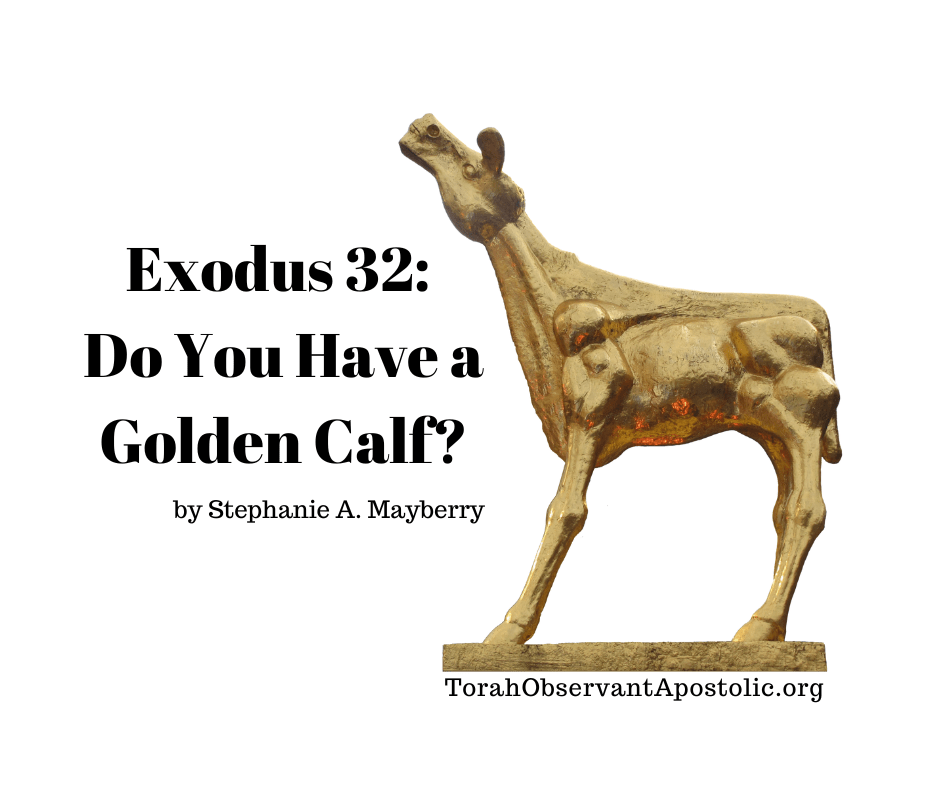
Just about everyone is familiar with the golden calf of Exodus 32 that the recently liberated Israelites were worshipping because they got tired of waiting for Moses to come down off the mountain.
And it almost got them killed.
But there is a much deeper meaning when you study it out, and a lesson we can all learn from.
In verse 1, the people got restless and started talking amongst themselves. They went to Aaron and appealed to him to make them a god to go before them (instead of Moses) because to them it seemed that Moses was MIA.
In response, Aaron instructed them to give him their golden earrings. This is where it gets interesting.
See, those earrings were remnants from their bondage in Egypt.
When the Egyptians would enslave someone, they would pierce their ears. That would symbolize the master’s control over that person. Yes, we can see this in Exodus 21:5-6, but throughout Torah we are taught that man is a servant of God, not a slave. Because he is a servant of God, he should not enslave himself to another master.
My question is, why were they still wearing the symbols of their slavery?
This tells me that while they had been physically delivered from their bondage, they had not been spiritually delivered.
In many ancient pagan cultures earrings and jewelry denoted social status, a higher class, if you will. It is quite possible that once they were delivered out of Egypt they held on to the jewelry, those symbols of their slavery and bondage, deciding instead to appoint it as a status symbol, as adornment.
But that doesn’t change the original intent and it definitely does not change the spiritual implications of its original intent – to symbolize a master’s control over his slave.
And that master was definitely NOT Yehovah God.
They were clinging to their Pagan traditions and being obedient to the spirit behind them which kept them in bondage. Sure, they walked freely, but spiritually they were still bound.
In verse 3, it says that they broke off the golden earrings. In some translations it says they stripped themselves. In the Hebrew text it can also mean to unburden or to unload a burden.
That’s very telling.
So, Aaron used an engraving tool and fashioned the gold into a molten calf. He then built an altar in front of it and told the people that the following day would be a feast to the Lord.
Why a calf? The most logical reason it would seem is that the calf was likely a representation of Apis, the Egyptian bull god.
Let’s break this down because there are a few problems here – problems that we see today. Can you spot them?
- Aaron created a golden calf, an idol for people to worship. What idols have you built? Before you answer, really consider it because they can be sneaky! Anything that you put before Yehovah God is an idol – even if you say it isn’t. Actions speak louder than words, my friend.
- Aaron said he was “doing it for the Lord.” (So, it should be OK, right??) How often have you heard people say that when they reject the fourth commandment to keep the Sabbath Holy (Exodus 20:8-11)
- Aaron created his own feast day to worship this calf made from pagan slavery jewelry – because he was “doing it for the Lord.” Now at that point, the Sabbath was well established among Yehovah’s people. Passover was also established (Exodus 12) as was the beginning of the biblical year and the feast of unleavened bread. So Yehovah was establishing HIS feast days. Aaron was creating extra-biblical ones – we see a lot of that today with Christmas, easter, and other holidays of Pagan origins.
In verse 7 Yehovah tells Moses, “Go, get thee down; for thy people, which thou broughtest out of the land of Egypt, have corrupted themselves:”
Verse 8 “They have turned aside quickly out of the way which I commanded them: they have made them a molten calf, and have worshipped it, and have sacrificed thereunto, and said, These be thy gods, O Israel, which have brought thee up out of the land of Egypt.”
They have corrupted themselves.
Many say they corrupted themselves because they constructed an idol and worshipped it, had an orgy, the works. And that is true. It’s pretty corrupt. But let’s dive a little deeper here.
Yehovah had Moses bring the Israelites out of Egypt and they turned around and pledged right back to it. And why? Because they felt that Moses was taking too long to come back.
Where’s the faith? The commitment?
Moses was their representative of Yehovah.
They lost that faith because they were going on emotions instead of sticking with what they KNEW.
How many times have you turned away from God because you couldn’t “feel” His presence, or you thought He was being “silent.”? Many allow those things to carry them down paths that they shouldn’t go down because of these very reasons. The parallel is pretty spot on.
Don’t let your “feelings” drive you. Stick with what you know. That’s commitment.
Another thing I’d like to bring out here is in verse 9 Yehovah refers to the people as “stiffnecked.” The definition is arrogant, rebellious, and stubborn.
How many Christians do you see today who fit that description? It is especially evident in those who have a half truth (have Torah but reject Acts 2:38 or have Acts 2:38 but reject Torah) as well as those who reject the feast days and cling to their pagan traditions like easter and Christmas.
It tells you where they are. They are in the same place that the Israelites were – in bondage. They were still clinging to that bondage as a matter of fact.
Those Christians defending and clinging to the pagan traditions are still wearing their golden earrings of slavery.
No wonder Yehovah was so angry! He delivered them and they walked willingly right back into their slavery! They weren’t working to shed the baggage of their bondage; they were using it to carry themselves right back into it.
And in verse 10 Yehovah was ready to wipe out every single one of them. He was that angry. Scripture says that His wrath waxed hot against them. That draws a horrifying picture.
Moses talked Yehovah out of killing them all, but they were so close!
And that is the hellfire that these rebellious Christians will face. Yes, they have Yeshua to beseech Yehovah to spare them the same way Moses beseeched Him to spear the Israelites, but they still have work to do just like the Israelites did. And in their rebellion, they cursed themselves because they never saw the Promised Land. They wandered the wilderness until that generation died off. Joshua and Caleb were the only ones from that generation who made it in.
When Moses came down from the mountain and saw what was going on, He was furious. He threw down the tablets from Yehovah, breaking them, and destroyed the calf. He ground it up and forced the children of Israel to drink it. He then confronted Aaron who promptly threw the Israelites under the bus, saying that they told him to do it.
In verse 26 we see wheat from chaff separation moment when Moses called for those who were on the side of Yehovah to come to him. All of the sons of Levi, the priestly tribe, came to him. Moses instructed them to go through the camp and kill those who were involved in the idolatry, which was most likely the ones who were leading it. The rest of the unfaithful later perished in a plague but the faithful lived. This tells us that not everyone was participating, but because of their association were punished. We see this same concept in the flood of Noah.
What Does This Mean for You?
We look at these Bible stories and see them for just that, stories. But there are great lessons there. Let’s break it down to see how it can be applied to your life as you grow in God.
The Israelites had learned Pagan traditions while in Egypt and they didn’t want to let them go. When you engage in those pagan traditions you are pledging your loyalty to those pagan masters. You are wearing the spiritual golden earrings of your slavery and the more you defend those pagan traditions (deepening your pledge to those pagan masters), the bigger your golden calf is.
And you say you are “doing it for the Lord”? That didn’t work out so great for Aaron or the Israelites.
The less obvious lesson here is about the spiritual bondage you cling to, often without even realizing it.
When you leave a “bad” situation or separate yourself from a person who is a spiritual liability you might feel you were “delivered” from it. In part that might be true, but there’s still work to do. You still have to be delivered spiritually and part of that is putting away all the things that are associated with that bondage because there are spiritual implications that come with it.
The Israelites were still in bondage even though they were physically separated from Egypt. When they used the gold that was from their slavery, their bondage, they turned their worship right back to the evil that enslaved them in the first place. They pledged their loyalty back to the master that enslaved them.
They went backward, yes, but I think a lot of people miss just how FAR they went back!
They essentially went back to Egypt because they took that gold from the earrings that were symbols of their slavery and created an idol to worship.
They were worshipping Egypt and returning to that master. It was a spiritual bondage and that is even more dangerous than physical bondage.
WOW
Moses’ reactions make even more sense now.
He’s like, “I just took you all out of Egypt and you are going right back!”
This speaks to me.
How many times have I gone back to past bondage because I did not completely divorce myself from it physically and spiritually?
Oh, keep that thing from that situation or person. It doesn’t matter, it’s just a trinket, a book, something they made for you – there’s any number of tokens or mementos that we might hang on to even if it came from a place or person who kept us in bondage.
No, it’s not “just a” anything. It’s a link, A LINK that can affect you spiritually.
Put
It
Down
Take a hard, honest look at what and who you have in your life. Do you have any golden earrings? Have you built any golden calves with them?
Are you clinging to the baggage of your bondage?
If so, it’s time to clean house.
Golden Calf Image by (Joenomias) Menno de Jong from Pixabay


 Torah Observant Apostolics