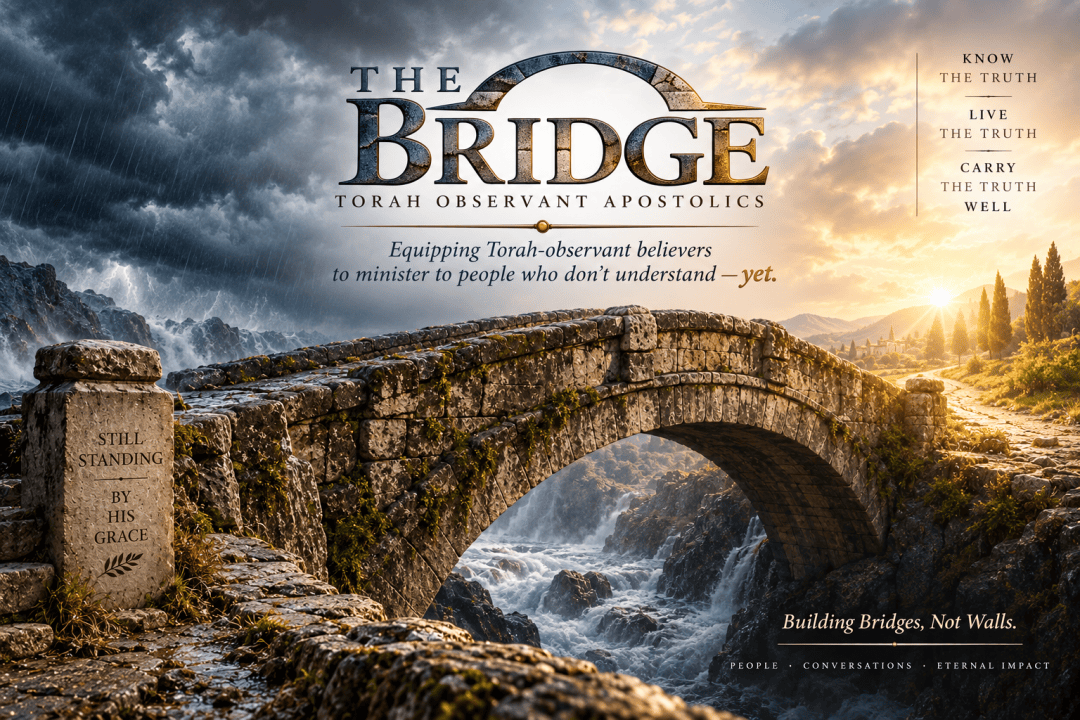
Building Bridges, Not Walls
Equipping Torah observant believers to minister to people who don’t understand yet.
You have seen something in Scripture that changed the way you live. Maybe it was the Sabbath. Maybe it was the feast days, biblical eating, or simply the realization that the whole Bible still matters.
And naturally, you want the people you love to see it too.
But knowing what you believe and knowing how to help someone else see it are two very different things.
Why The Bridge?
Many of us remember what it was like before we began walking this way.
Everyone has a story – and they’re all pretty similar.
You loved Yehovah. You read your Bible. You sincerely believed you were following Him. You wanted to walk in obedience to His Word. You were hungry.
Then something caused you to look again – look deeper.
Maybe someone asked you a question you couldn’t answer. Maybe you noticed a verse that didn’t fit what you had always been taught. Maybe you finally slowed down long enough to read the surrounding Scripture and realized it didn’t say what you thought it said.
Maybe you were just driven by your hunger to have a deeper, more meaningful relationship with your Creator.
Whatever brought you here is something that you probably come to overnight. In fact, most people don’t.
So why would you expect someone else to?
The Bridge exists to help Torah observant believers minister to people with patience, wisdom, compassion, and truth. We aren’t watering down Scripture, and we aren’t avoiding difficult truths. We are learning how to help people examine those truths for themselves.
Because the goal isn’t simply to get someone to agree with us.
Compliance Is Not Conviction
Suppose you finally convince someone to keep the Sabbath because you have been asking them to do it for months. They give in because they love you, want peace in the relationship, or simply want you to stop talking about it.
Have you really accomplished what you wanted?
They may be doing the right thing, but they are doing it for the wrong reason. If they are doing it for you, they are obeying you.
And you want something much deeper than that for them. We get it.
As believers, we want people to encounter truth in Scripture and respond to Yehovah because they love Him. We want them to obey because they have become convinced from His Word that this is what He desires—not because we pressured, argued, frightened, embarrassed, or exhausted them into compliance.
Our job is not to manufacture conviction.
We can open the Bible together. We can ask good questions, explain what we have learned, share our experiences, and help someone examine Scripture in context. But ultimately, they need a relationship with Yehovah in which His Word has authority over their lives.
That’s what will remain when we’re no longer standing beside them explaining it.
How Do We Build a Bridge?
We start by remembering that the person on the other side is a person—not a project.
We listen. We ask questions. We find out what they actually believe instead of assuming we already know. And when we open the Bible, we don’t begin with the goal of proving ourselves right.
We begin with the text.
That means we can say, “Let’s look at this together.” We can ask, “What do you see here?” We can give someone room to think, question, wrestle, pray, and come back tomorrow with another question.
Truth doesn’t become weaker because we handle people gently.
And patience doesn’t require us to compromise what Scripture says.
Remember Where You Came From
It is easy to forget how strange some of this sounded the first time you encountered it. Once something becomes obvious to you, it’s easy to slip off into “how can anyone possibly miss this?”
But you missed things too. We all did.
Someone may have taught you. Someone may have answered your questions. Someone may simply have planted a seed and trusted Yehovah to bring you back to it later.
You can extend that same patience to someone else. And that’s why we’re here.
The goal isn’t to drag people across the bridge.
It’s to walk with them while they learn to follow Yeshua for themselves.
Have Questions? Start With ASK.
Sometimes the best way to help someone understand isn’t to give them your answer. It’s to give them a safe place to ask the question.
Apostolic Sabbath Keepers (ASK) was created for people who are willing to open the Bible and examine what Scripture actually says. The studies encourage readers to slow down, look at the text in context, ask questions, and compare what they have been taught with the Word.
If someone you love is beginning to ask questions—or if you still have some questions yourself—this is a good place to begin.
Resources From The Bridge
The Bridge is growing.
As we develop Bible studies, articles, conversation tools, teaching resources, and practical guides, we’ll add them here. Each resource will have the same purpose: helping us communicate truth without building unnecessary walls between ourselves and the people we’re trying to reach.
And instead, building bridges.
We aren’t looking for better arguments.
We’re learning to become better disciples who know how to help make disciples.
Build the bridge. Open the Word. Let Yehovah work.


