
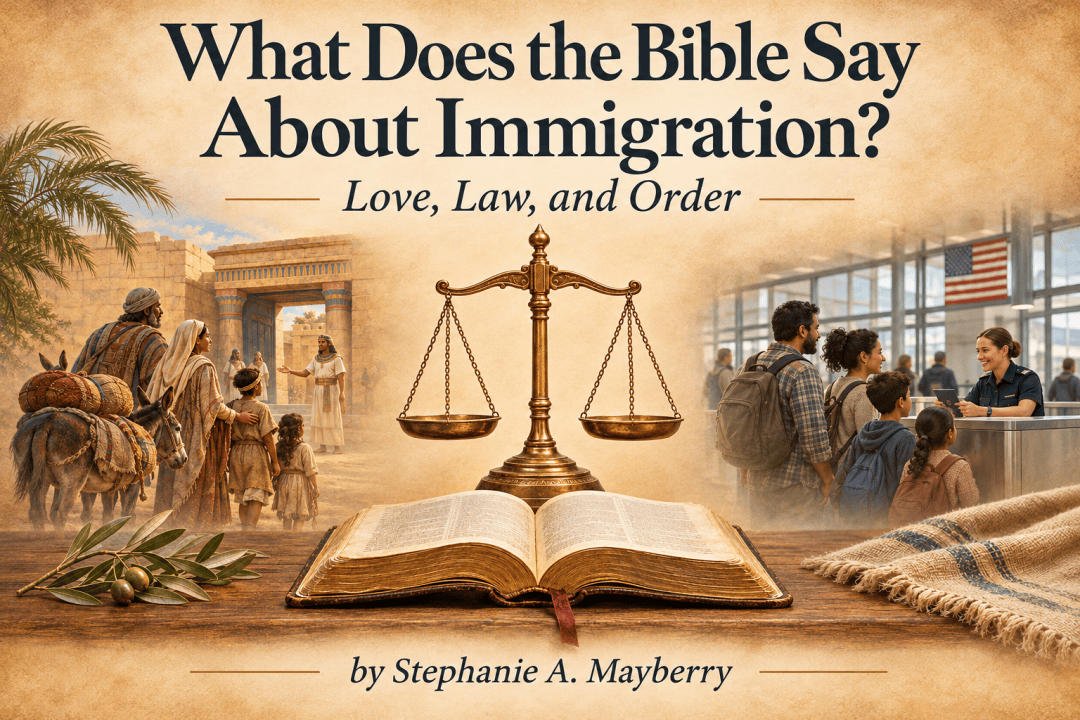
Welcome Has Never Meant Without Requirements
When immigration comes up, Leviticus 19:33–34 often enters the conversation:
“And if a stranger sojourn with thee in your land, ye shall not vex him. But the stranger that dwelleth with you shall be unto you as one born among you, and thou shalt love him as thyself; for ye were strangers in the land of Egypt: I am the LORD your God.”
—Leviticus 19:33–34, KJV
I agree with that command. We’re obligated to love the foreigner and refuse to mistreat him. But when someone takes those verses and concludes that a nation must admit everyone without requirements, I have a question: Where does Scripture say that?
See, you have to examine the whole Word, not just cherry-pick a few verses. You have to study to show yourself approved. That means studying Scripture, history, culture, and practices. You have to look at the whole picture in the whole Bible.
So, let’s do that.
The Hebrew word translated “vex,” or “mistreat” in other translations, is yānāh. It means to oppress, wrong, or maltreat. That’s a prohibition against abuse. Requiring an appropriate legal process for entry or residency is not, by itself, abuse. Establishing requirements can serve the purpose of maintaining order. Whether a particular requirement or its enforcement is unjust has to be examined rather than assumed.
But before you wave that away and hold onto your belief a little tighter, I want you to see something else in those verses. Yehovah tells the Israelites to remember that they were strangers in Egypt. That reference has a history, and the history deserves more than a passing glance.
How did their families come to live there? Here’s a quick summary.
Joseph was already established in Egypt as a high-ranking ruler under Pharaoh. There was a famine, and Joseph invited his family to come so he could provide for them. Pharaoh also expressly invited them, directing Joseph to bring his father and their households to Egypt. —Genesis 45:8–18.
In Genesis 47:1–6, Joseph presented his brothers to Pharaoh. They explained their circumstances and requested permission to settle in Goshen. Pharaoh approved their settlement, and Joseph established them there as Pharaoh commanded.
They didn’t seize Goshen. They didn’t just walk in and take over. They didn’t sneak in and try to circumvent Pharaoh’s authority in the land. They made a request, and the ruler of Egypt authorized their settlement. That deserves a second look.
They made a request, and the ruler of Egypt authorized their settlement.
There was an invitation, an appeal to the governing authority, permission, and an arrangement for where they would live. Their need was met through an orderly, authorized process.
Later, Joseph and his generation died. A new king arose who did not know Joseph. He feared the Israelites’ growing population and the possibility that they might join an enemy during a war and leave Egypt. He imposed taskmasters and forced labor. Their lives became bitter through harsh service, and Pharaoh eventually ordered the killing of their male infants. —Exodus 1:6–22.
That was oppression. Their ancestors had been welcomed and given a place to live; their descendants were enslaved and brutalized. When Yehovah reminded Israel of Egypt, the history He invoked included both authorized settlement and subsequent abuse. Those are distinct parts of the account.
We should preserve that distinction when applying the command today. There are many believers who think the Bible says that we are supposed to open our borders for whoever wants to come in, however they want, without any type of legal process. There are also non-believers who try to use Scripture to advocate for this as well.
Both show themselves as grossly unstudied.
The responsibility to respect civil authority also belongs in this discussion. Romans 13:1–7 directs believers to submit to governing authorities, identifying submission as a matter of conscience as well as consequences. In 1 Peter 2:13–17, submission to human institutions appears alongside the command to honor everyone. Scripture places respect for authority and respect for people together.
Respect for authority + Respect for people. One is never placed above the other.
Applying that responsibility to immigration, a believer has a sound biblical reason to follow the appropriate legal channels for entering and residing in another country. Likewise, they should respect and support their country when leadership puts such laws into place and enforces them. Crossing a national boundary doesn’t suspend the responsibility to respect governing authority.
That responsibility has a limit: obedience to Yehovah takes precedence when a human command conflicts with His. Acts 5:29 states that priority plainly. But the existence of that limit does not erase the general responsibility to submit.
Now consider the spiritual side of belonging.
A foreign resident could participate in Passover, but Exodus 12:48 established a requirement before participation. The males of his household had to be circumcised; then he could participate as a native of the land. Wanting to participate did not remove the requirement. Spiritual participation had a physical expression of obedience.
Deuteronomy 29:10–13 likewise includes foreign residents among those standing to enter Yehovah’s covenant and oath. They were being included in an established relationship with responsibilities. They weren’t being invited to rewrite its terms.
Being grafted in carries responsibility, too. Romans 11:17–22 describes an incoming branch receiving nourishment from an existing root. Paul says that the believer stands by faith, warns against arrogance, and warns of being cut off for failing to continue in Yehovah’s kindness. Being grafted in does not exempt you from obedience. You are brought into an existing covenant relationship through faith, and that faith calls for submission to Yehovah’s order.
Yeshua also identifies requirements for seeing and entering the Kingdom in John 3:3–5: being born again and being born of water and the Spirit. The desire to enter does not replace the birth He specifies. His welcome and His requirements exist together.
Kingdom entry and national immigration are different kinds of belonging. The comparison doesn’t give us a complete immigration code. It does, however, challenge the claim that having requirements is inherently incompatible with compassion. That claim doesn’t hold up against the order Yehovah establishes.
The Hebrew word gēr identifies a foreign resident; the word itself doesn’t establish which admission procedure that person followed. We don’t need to force that meaning into it to make the argument. The account of Joseph’s family supplies an example of authorized settlement, and the instructions concerning governing authorities supply a direct basis for respecting lawful processes.
A nation can welcome foreigners, require lawful entry and residency, and insist on humane treatment throughout the process. Believers can support those responsibilities together. Supporting legal requirements does not require defending every law or excusing cruelty, and showing compassion does not require treating every requirement as oppression.
If you quote Leviticus 19 to insist that foreigners must be loved, you’re quoting it appropriately. If you use it to insist that every admission requirement must disappear, you still have a lot of work to do to establish that conclusion. Scripture doesn’t support it.
Yehovah’s compassion does not cancel His order. His order does not excuse our cruelty. As believers, we’re responsible for honoring both.


