Imagine living in a town that has a church on every corner—but Sabbath rolls around, and you have nowhere to go.
There are so many churches and so many denominations. So many choices. There are worship services, Bible studies, prayer meetings, children’s ministries, and Christian communities all around you.
But none of them quite fit.
Add to that moving from Sunday church to the biblical Saturday Sabbath, and you’ve now narrowed your choices to almost nonexistent.
It seems ironic that the more you pursue God and the closer you get to Him, the less you fit in anywhere.
You haven’t rejected church. You haven’t decided that fellowship doesn’t matter. In fact, you probably desperately long for fellowship with like-minded believers.
You simply cannot find a congregation that believes what you believe.
Maybe you have come to believe that the biblical Sabbath is still important. Maybe you have studied the Torah and discovered that it is far more than a collection of ancient laws that no longer matter. Maybe you believe in the Apostolic message, baptism in Jesus’ name, the power and presence of the Holy Spirit, prayer, spiritual gifts, and a life of obedience.
Maybe you’ve heard the names “Yehovah” and “Yeshua” and feel a connection to spiritual roots you didn’t realize you had.
And perhaps you have discovered that finding all of those things together is surprisingly difficult.
You can find pieces of it.
But finding the whole picture feels nearly impossible.
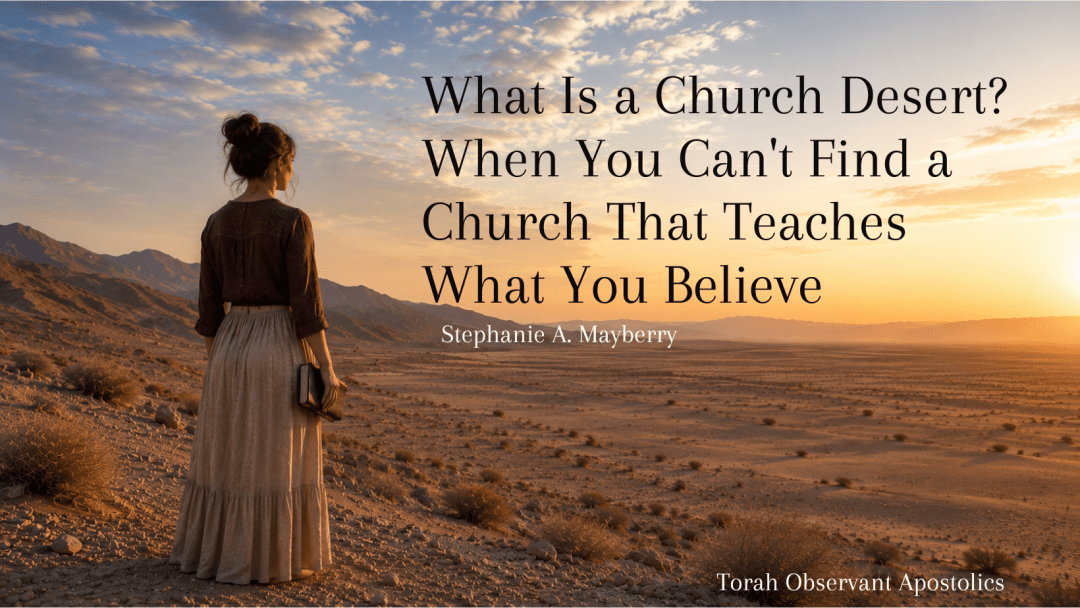
We call that a Church Desert.
And we know what it feels like because we have lived there.
What Is a Church Desert?
A Church Desert is a place where churches may be plentiful, but there is no local congregation that teaches the biblical convictions you are seeking to live by.
I coined the phrase because that’s what it felt like when we were in one. It felt like a church desert.
It doesn’t necessarily mean you live somewhere remote.
You can live in a city filled with churches and still be in a Church Desert.
The problem isn’t always the number of churches.
The problem is finding your church.
There are many believers on this journey who seek God with all their hearts and desire to please Him and obey Him. They are searching for a church that teaches both Spirit and truth—the Spirit that is essential to Apostolic doctrine and the truth of Torah.
It should be simple.
But it isn’t.
Scripture warns us about falling away from truth and turning from sound doctrine. It should be no surprise, then, that finding a body that holds firmly to the whole counsel of Scripture can be difficult.
Still, you think, There has to be something, somewhere.
Maybe you find a Sabbath-keeping fellowship, but it doesn’t incorporate the Apostolic doctrine and values that are important to you.
Maybe you find an Apostolic church, but Sabbath keeping and Torah are not part of its core beliefs or practices.
Maybe you find a congregation that talks about Torah, but prayer, the submission to the Holy Spirit, and the operation of the gifts of the Spirit aren’t emphasized in the way you believe Scripture teaches.
You may find people who agree with you on some of these things, but not all of them—or at least not enough of them to make you feel like that’s where you belong.
And after enough searching, you may begin wondering:
Am I the only one?
When There Are Churches Everywhere—but None for You
This is one of the strangest things about a Church Desert.
You can drive past church after church and still feel spiritually homeless.
From the outside, it may be difficult for other people to understand. You really have to walk down that road to understand the snags and brambles—the struggle of the journey.
They may say, “There are plenty of churches around here. Just pick one!”
But if you have spent years studying Scripture and developing convictions about how God has called you to live, “just pick one” isn’t an option.
You aren’t looking for a perfect church.
You aren’t looking for people who agree with you about every minor point.
You are looking for a body of believers that believes, teaches, practices, and lives what God’s Word teaches—not man’s word.
And drawing that line matters.
A Church Desert isn’t necessarily a place without believers.
It is a place where the fellowship you are seeking cannot be found locally.
And that can be incredibly lonely.
We Know What It Is Like to Search
We aren’t writing about this from a distance.
We walked this ourselves.
My husband and I spent more than five years looking for a body of believers that shared what we had come to understand from Scripture.
We looked, prayed, and studied.
We talked to people.
And again and again, we found pieces of what we were seeking—but not the whole.
We found people who were deeply committed to Torah, but we weren’t finding the spiritual life we were seeking.
We found Spirit-filled and Apostolic people, but Torah and Sabbath were not part of their understanding or practice.
We found people who identified as Apostolic, but we weren’t finding the emphasis on prayer and the work of the Holy Spirit that we believed should characterize the life of a believer.
We weren’t looking for a label.
Our list was simple.
We were looking for a life of faith that brought these things together.
We wanted whole-Bible teaching that emphasized full and true obedience and submission. We wanted Scripture to be taken seriously from Genesis to Revelation, with an understanding of Torah, the Sabbath, and the Feast Days.
We wanted Apostolic faith with a strong foundation of prayer—because it is the foundation of everything.
We wanted the Holy Spirit to lead our services, our ministries, and our lives.
We wanted genuine fellowship, community, a body.
We didn’t want to check a few church boxes to fill our obligation for the week. We weren’t interested in just getting our little taste of the Holy Ghost, dancing around, clapping our hands, and then going home.
That’s religion.
We wanted the life.
And we wanted to walk in that life with other like-minded believers—other human beings with a heart for our Creator and a desire to allow Him to order their steps.
We wanted other believers who valued obedience and submission over ego and pride.
We wanted to find people who love God, love His Word, and simply want to live their lives according to His purpose for them.
And that was the thing we couldn’t seem to find.
Still, we pressed on. We kept looking and praying.
For more than five years.
And full disclosure, sometimes we felt like God forgot about us.
Spoiler. He didn’t forget about us. He saw everything. And He was about to do something amazing. We just needed to be on that potter’s wheel a little longer.
“Why Don’t You Become What You Seek?”
After more than five years of searching, we were tired.
Not tired of seeking Yehovah or studying His Word.
Not tired of praying.
We were tired of looking for something that seemed so simple in our minds and yet was so difficult to find.
And honestly, we were tired of being disappointed.
We tried to maintain the relationships we’d formed, but it rarely worked out. Long-distance relationships are tough to maintain.
And you can live across town from someone but still be spiritually miles apart.
It’s not the geographical miles that make the relationship difficult. It’s the spiritual ones. When you’re trying to build deep spiritual fellowship, those miles can be much harder to bridge.
We had prayed for a body of believers who wanted to live according to the whole counsel of Scripture. We wanted Torah and Sabbath and the Feast Days. We wanted Apostolic doctrine. We wanted prayer and the Holy Spirit to be central to the life of the assembly.
We wanted people who weren’t simply checking a box on Sunday—or even Saturday—but who genuinely wanted to live their lives in obedience and submission to Yehovah.
And then, one day, while my husband was praying, something happened that changed everything.
Yehovah spoke to him in that still, small voice:
“Why don’t you become what you seek?”
That wasn’t exactly the answer we had been expecting.
And if I’m being completely honest, we weren’t sure it was the answer we actually wanted.
Lead a body of believers?
That is a massive responsibility.
My mind immediately went to Hebrews 13:17:
“Obey those who rule over you, and be submissive, for they watch out for your souls, as those who must give account.”
That’s what Yehovah was talking about!
That was where He wanted to put us.
I had always been on the obedience side. It had never even entered my mind that we would someday be on the watching out for souls side.
It’s one thing to walk this walk and try to live our lives as close to Scripture as possible.
It’s a whole other story when the God of the Universe is putting souls in your hands to care for and nurture—and telling you that you will be held accountable for them.
We had been asking Yehovah to show us where the fellowship we were seeking could be found.
Instead, He began showing us—or, more specifically, leading us—to become what we were looking for.
The “Why don’t you?” was a reminder that we still had a choice.
But who in their right mind chooses to step outside of Yehovah’s will?
So we took up the charge.
Becoming What We Were Seeking
That moment, that prayer, that answer became the beginning of something we never could have planned for ourselves.
Torah Observant Apostolics is how we became what we were seeking.
We weren’t trying to create another denomination.
We weren’t looking for a platform.
We weren’t trying to build a ministry because we thought the world needed another website or another place to watch sermons.
We were responding to a need we had personally experienced.
We had been searching for a body of believers that took the whole Bible seriously and who wanted the truth of Torah and the Spirit of the Acts 2 experience.
We had been searching for a fellowship where prayer wasn’t an afterthought, where the Holy Spirit wasn’t merely a doctrine, and where obedience to Yehovah wasn’t separated from faith.
We had been searching for a body of like-minded believers.
And it was then that “Are we alone?” turned into “There must be others like us!”
Why would Yehovah offer this option and bring that Scripture to my mind if He didn’t intend for us to reach out into the highways and byways?
So we began building what we had been searching for.
My husband is the pastor, or elder. I am his wife. Scripture says we are one flesh, so that means we are both called.
He leads, and I am submitted to his Yehovah-given spiritual authority over our family. But we are a team. We work together to grow and nurture this ministry.
I am explaining this because this experience changed the way we saw other people who were still searching. Once you have walked through a desert yourself, you recognize other people who are wandering through one.
You know the questions.
You know the frustration.
You know the disappointment.
You know what it feels like to wonder if you’re the only one.
And you understand why someone may be hesitant to trust another church, another ministry, or another group of believers.
You’ve already looked.
You’ve already been disappointed.
Maybe you’ve even compromised at some point out of sheer desperation for community—and regretted it.
Maybe you’ve decided that being alone is safer than being spiritually misplaced.
We understand.
We were there too.
And we want you to know, we see you.
Then We Discovered How Many People Were Still Searching
As Torah Observant Apostolics developed, I became increasingly burdened for people who were scattered in the same way we had once been scattered.
My husband already had a burden for people. He loves people!
I was more reserved. I loved people, but it wasn’t until Yehovah put that burden on my heart to be a beacon in that Church Desert that I truly understood the heart-wrenching desire to help them.
I felt strongly led to incorporate an online ministry.
We had been meeting in our living room with several people, but Yehovah kept pressing me, telling me that I had a powerful ministry tool with almost unlimited reach right in front of me.
My husband was reluctant at first.
Let’s be honest, technology is not really his friend.
He was naturally apprehensive. He may have even said at one point, “Are you out of your mind?”
That’s when I told Yehovah:
“You need to talk to my husband about this. I’m just scaring him.”
And that’s exactly what happened.
Yehovah started dealing with my husband in His own gentle way, calling him deeper into that relationship.
One day, over coffee, as we were getting ready to pray, my husband looked at me and said:
“OK. Let’s do it.”
An online ministry wasn’t what either of us had originally imagined when we began.
But Yehovah knew exactly what He was doing.
Of course He did.
And we stepped into it on literally nothing but pure faith.
What happened next surprised us—although you probably shouldn’t be surprised when Yehovah’s projects work out.
People began finding us.
They were asking questions, looking for resources, and best of all, seeking fellowship.
People traveled to us to sit in on a Sabbath, join us for a Feast Day celebration, and be baptized in the name of Yeshua.
We discovered that the Church Desert wasn’t nearly as small as we had imagined.
There were people all over who had been searching for the same combination of biblical convictions we had spent years searching for.
Some were keeping Sabbath but couldn’t find fellowship.
Some had discovered Torah but were looking for a Spirit-filled Apostolic environment.
Some had come from Apostolic backgrounds and were beginning to ask questions about Sabbath and Torah.
Some had been studying alone for years.
Some had been praying for a fellowship where they could finally stop explaining why these things mattered.
They weren’t all in the same place in their understanding.
They didn’t all use the same terminology.
They didn’t all have the same history.
But they had something in common.
They were searching for something more than what they had. They were seeking a deeper, more intimate relationship with their Creator—and a body that supported that.
And we recognized them because we had been searching for those things too.
We Didn’t Want to Build a Stage
That distinction has remained important to us.
We didn’t want to create an online ministry where people simply logged in, watched a sermon, and logged out.
And we definitely didn’t want to just be a talking head on a broadcast.
We wanted fellowship. We wanted people who wanted to get to know one another.
We wanted prayer, questions, discussion, all the things you do when you walk out of the sanctuary and linger in the hall (or parking lot – my husband teases me that I have a strong parking lot ministry) just spending time with each other, building relationships, building community.
We wanted people to participate rather than simply consume religious content.
We wanted a place where someone living hundreds of miles from the nearest like-minded congregation could still have a spiritual family.
That is why TOA ONLIFE became so important.
It wasn’t born from a marketing strategy.
It was born from a Church Desert.
We knew what it was like to search for a place to belong, and we knew there were others still searching.
So we decided to make room for them at our table.
What Do You Do When There Is No Church Near You?
So, you’ve searched and prayed, and there really isn’t a church near you that shares your convictions? What do you do?
First, don’t give up on fellowship.
And don’t assume that because you can’t find an established congregation nearby, you are destined to walk this path alone.
Keep studying, praying, and seeking Yehovah. Keep looking for other people who are seeking Him too. They may be closer than you think.
Maybe you know another family that has begun keeping Sabbath. Your mother may be asking some of the same questions you were. You might have a friend who has been studying Torah or asking you why you believe what you do.
Maybe there are two or three people in your community who have been sitting in their own homes every Sabbath thinking they are the only ones.
Find each other.
You don’t need a church building to gather with other believers.
Open your home, share a meal. Pray together. Open the Scriptures and study. Talk about how Yehovah is blessing you. Keep Sabbath together.
Start building the fellowship you’ve been praying to find.
Build what you have been seeking.
Remember, the early church wasn’t built around elaborate buildings and polished programs. Believers gathered in homes. They ate together, prayed together, studied together, worshiped together, and became part of one another’s lives.
Your living room can become a place of fellowship too.
If you are beginning a home gathering or simply trying to figure out what that might look like, TOA has a free Tips for Hosting a TOA Gathering guide available on our Free Resources page.
Online Church Doesn’t Have to Mean Sitting Alone
This is something we especially want people living in a Church Desert to understand.
Joining an online service doesn’t mean you have to sit alone on your sofa staring at a screen every Sabbath.
We have people who join us on their own, and that’s perfectly fine. But we also have people who join TOA ONLIFE as families. We’ve had people bring their mothers, brothers, sisters, and cousins. Others invite friends.
And there’s absolutely nothing stopping you from inviting other believers into your home and having your own little TOA watch party on Sabbath.
Make some food and invite someone to join you for the service. You can listen to the teaching, join the discussion, pray together, and grow in God together.
After service you can turn off your computer and keep fellowshipping. Eat, laugh, pray, talk.
That’s a gathering.
Maybe it’s just two or three of you. That’s okay.
Maybe there are twelve. That’s okay too.
And if it’s just you, know that you’re not alone.
The point isn’t how many people are sitting in the room.
The point is that a Church Desert doesn’t have to convince you that fellowship is impossible.
Technology can connect your little gathering with believers hundreds or thousands of miles away while the people sitting beside you provide the face-to-face fellowship you’ve been missing.
One doesn’t have to compete with the other.
They can work together.
And if you are the only one in that room, fellowship with us online after the service—and beyond.
We have several communication channels that we use, including Telegram, text, phone, and Facebook Messenger.
We’re a family, not just a group of people that comes together a couple of times a week.
Don’t Let the Desert Convince You That You’re Alone
Isolation can do something to you if you live with it long enough.
You start to feel like you have to shoulder everything on your own. You begin expecting to study alone, pray alone, keep Sabbath alone, and celebrate the Feast Days alone.
Eventually, you can begin thinking, I guess this is just what my walk with Yehovah is going to look like.
And you start to get comfortable in that solitude.
But it doesn’t have to be that way.
We were created for community. Even Yeshua traveled with His disciples and other believers, taking periods to be alone in prayer but returning to the people around Him.
There may be someone ten minutes away asking Yehovah for exactly what you’re asking Him for.
There may also be someone ten states away who understands your spiritual journey better than anyone you’ve met locally.
The internet has this incredible ability to build bridges that span miles, giving us the ability to find each other.
But finding each other is only the beginning.
The goal is relationship, fellowship. It’s encouraging one another, praying for one another, studying the Word together, and helping one another remain faithful.
That’s where online fellowship can become incredibly valuable for someone living in a Church Desert.
Not because a screen can replace people.
But because sometimes a screen is what helps you find your people.
Can Online Church Really Be Fellowship?
That’s a fair question.
And we’re not going to pretend that gathering online is identical to sitting around the same table.
It isn’t.
There is something precious about being physically present with other believers. There is something special about sharing a meal, hearing someone pray beside you, hugging someone who is hurting, and simply doing life together.
And it is incredibly powerful to have someone lay hands on you and pray for you.
Technology can’t reproduce all of that.
But that doesn’t mean the fellowship happening through technology isn’t real.
And it doesn’t mean that you can’t have a move of God right there where you are.
We’ve seen it happen. We see it happen at every service.
People feel the powerful, awesome presence of God as He moves on them.
That’s one of the things we intentionally built into TOA ONLIFE, our online ministry. That is what we mean by “Spirit-led” services. We don’t try to order the services. That’s Yehovah’s job. He leads and we follow. This leaves room for Him to move on us, heal us, and transform us.
There’s a significant difference between watching a livestream and participating in a gathering.
We didn’t create TOA ONLIFE simply to broadcast a sermon.
We gather live.
We encourage cameras because we want to see one another, not preach to a collection of blank squares.
We come together to hear what Yehovah has to say, what He has led us to teach.
And when the teaching is finished, people can stay.
They talk, discuss the lesson, pray for each other, share what’s happening in their lives, and get to know one another.
Relationships begin to form.
Over time, faces become familiar and strangers become friends.
That’s what we wanted from the beginning.
Not an audience.
A body.
Because if you’re living in a Church Desert, you probably don’t need another sermon to watch.
There are millions of those online.
What you’ve been looking for is somewhere to belong.
If you’re wrestling with Hebrews 10:25 or wondering whether participating in church online means you are “forsaking the assembling,” we’ve addressed that question in greater depth in Forsake the Assembly? Does Online Church Violate Scripture?
We Were Created for Biblical Fellowship
That desire to belong isn’t weakness or neediness.
And it isn’t evidence that your relationship with Yehovah isn’t strong enough to sustain you on your own.
We were created for fellowship.
From the beginning, Yehovah created human beings for relationship with Him and with one another.
We see that pattern continue throughout Scripture.
After the outpouring of the Holy Spirit in Acts 2, the newly established body of believers didn’t simply receive the Spirit and then return to their individual lives.
Acts 2:42 tells us:
“And they continued stedfastly in the apostles’ doctrine and fellowship, and in breaking of bread, and in prayers.”
Look at what was happening there.
Doctrine.
Fellowship.
Breaking bread.
Prayer.
They were learning together.
They were eating together.
They were praying together.
They were living their faith together.
Hebrews 10:24–25 gives us another important piece:
“And let us consider one another to provoke unto love and to good works: Not forsaking the assembling of ourselves together… but exhorting one another…”
Notice that the purpose wasn’t simply attendance.
It was one another.
Encouraging one another.
Strengthening one another.
Provoking one another toward love and good works.
Biblical fellowship isn’t about occupying the same building for a couple of hours every week.
It’s about becoming part of one another’s lives.
That’s why living in a Church Desert can hurt so much.
You’re longing for something Scripture teaches us to value.
Fellowship Was Never Supposed to Be a Spectator Sport
When we look at the gatherings described in the New Testament, we see participation.
People prayed. They taught and encouraged each other. They shared the fruit of their studies and asked questions. They ate together and ministered to one another.
Paul describes the body in 1 Corinthians 12 as many members functioning together. A hand isn’t the whole body. Neither is an eye. Each member has a place and a purpose.
That’s a very different picture from one person doing everything while everyone else watches.
And it’s one reason we care so much about participation in TOA ONLIFE.
We don’t want you to disappear into an audience.
We want to know you—and we want you to know us.
And we want you to know the other people sitting in their homes looking back at you.
Because somewhere behind one of those cameras may be someone who understands exactly what you’ve been going through.
They may have spent years searching too.
Are You Living in a Church Desert?
Maybe you’ve been reading this and thinking, This sounds like me.
Maybe it is.
You may be living in a Church Desert if:
- There are plenty of churches near you, but none keep the biblical Sabbath.
- You’ve searched for a Sabbath-keeping church but haven’t found one that shares your other convictions.
- You’ve embraced Torah but can’t find a Torah-observant Apostolic church near you.
- You come from an Apostolic background but have begun studying Torah, Sabbath, or the Feast Days and suddenly find yourself without a spiritual home.
- You believe strongly in prayer and the work of the Holy Spirit but can’t find those things together with Torah observance.
- You spend most Sabbaths studying or worshiping alone.
- You long for people with whom you can discuss what you’re discovering in Scripture.
- You’ve searched online for a church that believes what you believe.
- You’ve wondered, “Am I the only one?”
- You’ve considered compromising convictions simply because you’re tired of being alone.
If you recognize yourself in several of those statements, you understand what we mean by a Church Desert.
But there’s something we want you to understand even more:
A Church Desert describes where you are.
It doesn’t have to determine where you stay.
You May Be Far Away, But You Don’t Have to Be Alone
We spent more than five years searching.
At the time, we couldn’t see what Yehovah was doing with any of it.
We just knew we were looking for something we couldn’t seem to find.
Looking back now, we can see that those years gave us something we could not have learned from a book.
They taught us what the desert feels like.
That’s why we recognize the person who is still wandering through it.
We understand the frustration, the disappointment, the questions, the uncertainty, the loneliness.
And we understand that sometimes you aren’t looking for another doctrine to adopt or another sermon to watch.
You’re looking for your people.
People who love Yehovah, love His Word, want His Spirit, and value prayer. People who want to walk in obedience to Him and His Word.
People who aren’t interested in religion for religion’s sake but genuinely want to know their Creator and live according to His purpose.
That’s what we were looking for.
And that’s what we’re still building.
There Is Room at the Table
If you’re living in a Church Desert, we aren’t going to tell you that an online ministry magically solves everything.
It doesn’t.
We will encourage you to find believers near you when you can.
Invite people into your home.
Build relationships.
Pray together.
Study together.
Keep Sabbath together.
And if you’re still searching for that fellowship, come sit at our table while you search.
Join us for Sabbath. Gather a few people in your living room and have a TOA Watch Party, or come by yourself and let us get to know you.
You don’t have to have everything figured out before you show up.
People are at different places in their journey, and that’s okay.
Come learn with us. Pray with us. Ask questions, fellowship, grow.
Because the Church Desert taught us something we never want to forget:
There are people everywhere searching for one another.
Sometimes they just need a place to meet.
That’s what we want TOA ONLIFE to be.
Not another broadcast.
Not another audience.
A body.
And if you’ve been wandering through a Church Desert looking for somewhere to belong, perhaps it’s time to pull up a chair.
There’s room at our table.
Frequently Asked Questions About Church Deserts
What is a Church Desert?
A Church Desert is an area where churches may be plentiful, but there is no accessible local congregation that shares the biblical convictions you are seeking to live by. You can live in a large city surrounded by churches and still experience a Church Desert.
What do I do if there is no church near me that believes what I believe?
Keep studying, praying, and seeking Yehovah. Look for other believers nearby, even if there are only two or three of you. Consider gathering in a home for Sabbath, prayer, Bible study, and fellowship, and use online fellowship to connect with a larger body when geographic distance makes local fellowship difficult.
How can I find a Sabbath-keeping church near me?
Look beyond labels and examine what a congregation actually teaches and practices. Ask about the biblical Sabbath, Torah, prayer, the Holy Spirit, Apostolic doctrine, and any other convictions that are important to you. If no local congregation shares those convictions, an interactive online Sabbath fellowship can help bridge the distance.
Is there an Apostolic church that keeps the Sabbath?
Yes, there are believers and ministries that combine Apostolic doctrine with biblical Sabbath observance and Torah. They are far less common than churches that hold only one of those sets of convictions, which is one reason some believers find themselves living in a Church Desert.
Can I have church in my home?
Believers gathered in homes throughout the New Testament. A home can be a place for prayer, Bible study, meals, worship, and genuine fellowship. A small home gathering can also participate together in an interactive online service, connecting local fellowship with a larger body of believers.
Does online church violate Hebrews 10:25?
Hebrews 10:25 teaches believers not to forsake assembling together and emphasizes encouraging one another. We believe meaningful online fellowship can help believers assemble, encourage one another, pray, study, and participate when distance prevents regular physical gathering. We explore this question more fully in Forsake the Assembly? Does Online Church Violate Scripture?


