
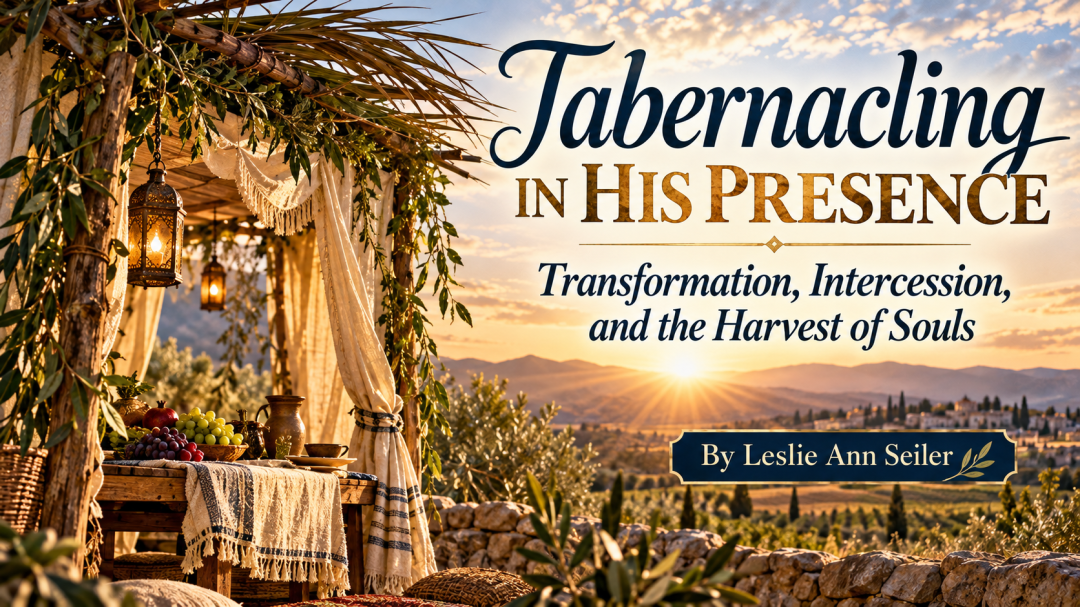
Introduction: The Command to Dwelling
Every year as the autumn winds begin to blow, a unique command goes out to the people of Yehovah. We are called to leave the comfort of our permanent homes, step outside, and dwell in temporary shelters. This is Sukkot, the Feast of Tabernacles. On the surface, it is a historical reminder of the wilderness wanderings. But on a deeper, prophetic level, Sukkot is an invitation to intimacy. It is the Zman Simchatenu—the Season of Our Joy—marking the great fall harvest, the final ingathering of the labor of the fields.
Yet, before there can be a harvest in the fields, there must be a plowing of the heart. Before we can celebrate the joy of the ingathering, there must be a season of dwelling deeply in the presence of the King. Real transformation does not happen through religious activity or human effort; it is birthed entirely through the Word and prayer. When we tabernacle with Yehovah in the secret place, His heartbeat becomes our heartbeat. We stop praying for our own kingdoms and begin travailing for His.
Section 1: Dwelling in the Secret Place
My own journey into this reality began with a simple, unexpected mandate. Although I had received the gift of the Ruach HaKodesh with the evidence of speaking in tongues and had been immersed in the saving name of Yeshua when I was much younger, I didn’t actually begin attending a local congregation until I was in my twenties. I was young in the faith, eager, and full of zeal.
Like many new believers, I wanted to do something. I went to my Elder, looking to him for direction, and asked what my assignment should be. I expected a task, a program, or a group assignment. Instead, he looked at me and gave me a directive that would alter the course of my life:
“I want you to pray.”
It was a mandate to step into the ultimate sukkah—the shelter of the Most High. I took that instruction to heart. I began spending my mornings at the church building in prayer, and my evenings were consumed with intercession and deep study of the Word. I wasn’t trying to build a ministry; I was developing a relationship with Yeshua.
It was in those quiet, hidden hours that the transformation occurred. When you spend that much time looking into the face of the Savior and consuming His Word, you cannot remain the same. The Word begins to align your mind, and prayer begins to reshape your heart. Slowly, Yehovah began to share a sacred, heavy gift with me: He let me feel His burden for a lost and dying world.
I began to see that prayer is not a shopping list we present to the Almighty; it is a divine exchange. In the secret place, we exchange our small, short-sighted desires for His global, redemptive passion. We begin to care about what He cares about. And what Yeshua cares about above all else is seeking and saving that which is lost.
Section 2: The Harvest in the Aisles and Offices
None of the fruit that followed in my life would have happened without those hours spent hidden away in prayer. When you are saturated in the Word and matching the heartbeat of the Savior, you become hyper-sensitive to the promptings of the Ruach HaKodesh. You begin to move not by human logic, but by divine orchestration.
One day, I was driving past a local grocery store when the Spirit of Yehovah gripped me with a clear, undeniable prompting: Stop and go inside. I had no errands to run, but I obeyed. I walked into the store and began simply walking up and down the aisles, waiting on the Lord. That is when I came across an elderly gentleman named Clyde. He was staring intensely at the shelves, clearly struggling to find a specific can of soup. What I didn’t know at that moment was that Clyde couldn’t read.
Moved by compassion, I stepped in and asked if I could help him find what he was looking for. After we found his soup, the door of his heart swung open. I asked him right there if I could teach him a Bible study. He agreed. That study led Clyde to a life-changing revelation of the gospel. We took him down to the river and immersed him in the saving name of Yeshua. The very next church service, Yehovah poured out His promise, and Clyde was filled to overflowing with the Holy Spirit. Today, Clyde sleeps in Messiah, awaiting the sound of the last trump and his resurrection into immortality.
The Spirit operated the same way in the professional world. I was working as an administrative assistant at a large corporation, a busy environment driven by intellect and structure. One afternoon, a man I had never once met or spoken to walked up to my desk. His name was Mike, and he was an engineer at the company. Looking back, it is clear the conviction of the Holy Spirit was already wrestling with him. He looked at me and felt completely compelled to ask a single, sudden question: “Where do you go to church?”
That conversation turned into another Bible study. Mike eagerly received the truth, was baptized, and was filled with the Ruach. But the harvest didn’t stop with him. As an engineer, Mike had an analytical mind but a radically transformed heart; he immediately went out and brought his friends, colleagues, and family members to hear the truth. Through that single connection birthed by the Spirit, dozens of people found redemption and entered the Kingdom.
Section 3: The Travail of the Bride and the Groaning of Creation
These were not victories of human eloquence or clever programs. They were the direct, tangible results of a heart transformed in the secret place to match the desires of our Savior.
When we study the Moedim (the appointed times), we see that Sukkot is celebrated as the ultimate Feast of Ingathering. It is a season of immense joy (Zman Simchatenu). But scriptural patterns show us a profound paradox: the joy of the harvest is always preceded by the agony of travail.
The Scriptures give us a vivid picture of this through Rachel. In her desperation for lineage and fruitfulness, she cried out to her husband, “Give me children, or else I die!” (Genesis 30:1). This is not just historical narrative; it is a prophetic picture of the Bride of Messiah. A true Bride cannot sit idly by, content with her own comfort, while the world around her perishes. When the Bride’s heart aligns completely with the heart of her Husband, her Beloved, she takes on His burden. She enters into a “ministry of weeping.” She begins to cry out in intercession, “Give me spiritual children, or else I die!”
This deep internal crying mirrors the cosmic reality described by the Apostle Paul in Romans 8. He reminds us that the entire creation is currently groaning and travailing in pain, waiting expectantly for the adoption—the ultimate redemption of the body (Romans 8:22-23). Creation itself is locked in birth pangs, waiting for the manifestation of the sons of God.
When we step into deep prayer and the Word, our personal groaning links up with the groaning of creation. We begin to weep over the brokenness of a lost world because we see the finish line. We see the true, ultimate fulfillment of Sukkot: the Millennial Reign of Yeshua, where the earth is finally redeemed from the curse, the wicked are removed, and the meek truly inherit the earth.
Section 4: Zechariah 14 and the Ultimate Ingathering
When we understand that our prayers are directly linked to the birth pangs of the Kingdom, the prophetic weight of Sukkot becomes breathtakingly clear. The Prophet Zechariah looks down the corridors of time to the Millennial Reign and declares a staggering truth about the future of the earth:
“And it shall come to pass that everyone who is left of all the nations which came against Jerusalem shall go up from year to year to worship the King, Yehovah of hosts, and to keep the Feast of Tabernacles.” (Zechariah 14:16)
Think of the magnitude of this prophecy. In the Millennial Kingdom, when Yeshua sits upon the throne of His father David and the meek inherit the earth, Sukkot is a feast that the entire world must celebrate.
Zechariah goes on to warn that any nation failing to come up to Jerusalem to keep the Feast of Tabernacles will receive no rain (Zechariah 14:17).
Why is Sukkot singled out during the Millennial Reign? Because it represents the ultimate completion of Yehovah’s redemptive plan. It is the final, global ingathering of the souls of men and women from every tribe, tongue, and nation. It is the physical manifestation of Romans 8, where creation is finally delivered from its bondage to corruption and brought into glorious liberty.
But notice the condition Zechariah mentions for the rebellious: no rain. In Scripture, rain is always tied to the pouring out of the Ruach HaKodesh and the watering of the spiritual seed.
If we want to see the rain of the Spirit fall on our families, our neighborhoods, and our communities today, we must choose to “keep the feast” right now in the secret place.
We must build that sukkah of prayer in our daily lives, tabernacling with the Word until the spiritual rain falls and brings forth life.
Conclusion: A Call to the Secret Place
Every great harvest of souls—whether it is an elderly man named Clyde finding salvation in a grocery aisle, an engineer named Mike turning a corporate office upside down for the gospel, or the final ingathering of the nations in Jerusalem—begins the exact same way. It begins when a child of Yehovah hears the mandate of the Spirit and says, “I will pray.”
Transformation is not something we can manufacture through clever words, programs, or religious verbosity. It is a supernatural work birthed when the Word takes root in our hearts and prayer aligns us with the heartbeat of our Savior.
As we step into this season of Sukkot, let us look beyond the physical branches of our temporary shelters and look into the depths of our own hearts. Let us take up the travail of the Bride. Let us weep over the lost, sow precious seeds in tears, and fiercely intercede for the redemption of the world.
When we align our hearts with His, we can live in the absolute assurance of Psalm 126:5: “Those who sow in tears shall reap in joy.” May Yehovah find us faithful in the secret place, tabernacling in His presence, until the last trump sounds and the ultimate harvest is brought home.
Chag Sameach Sukkot! (Happy Sukkot!)
by Leslie Ann Seiler


One thought on “Tabernacling in His Presence: Transformation, Intercession, and the Harvest of Souls”