
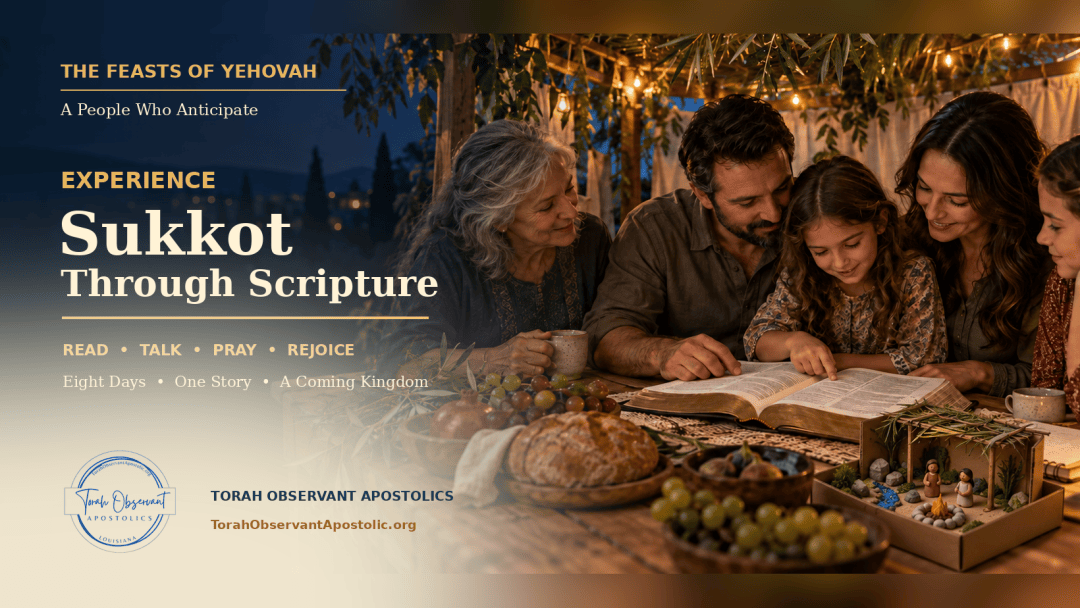
Welcome to Experience Sukkot Through Scripture.
Over the next eight days, we will walk through the meaning of Sukkot as a family. We will remember how Yehovah cared for Israel in the wilderness, recognize His provision in our own lives, rejoice before Him, and look ahead to the coming Kingdom when Yeshua will reign upon the earth.
Each day includes a portion of Scripture to read together, a brief devotional, discussion questions, and a family prayer. You will also find the Sabbath Kids Sukkot Bible Adventure and Scripture Scavenger Hunt here so your family can build, draw, explore, and experience what you are learning.
A new devotional will be added each day. Do not feel that you need to rush through anything or produce perfect answers. Open the Word, talk together, and give everyone room to notice what Scripture is showing them.
Let’s begin.
Day 1: He Came to Dwell With Us
Read Together: Leviticus 23:33–35 and John 1:1–14
Sukkot begins with a High Sabbath.
Yehovah calls His people to stop their regular work, gather together, and turn their attention toward Him. It is a holy day—not because people decided to make it special, but because Yehovah did.
And on this first day of Sukkot, we remember something wonderful.
Yeshua came to dwell among us.
John tells us that the Word became flesh and “dwelt among us.” That word carries the idea of pitching a tent or tabernacling among people.
Yehovah did not remain somewhere far away from us. He came in flesh. He entered the noise, pain, and ordinary routines of human life. He walked among His people, touched people others avoided, ate at their tables, taught them the Word, and showed them who He is.
We believe Yeshua was born on the first day of Sukkot. What better time for the One called Immanuel—God with us—to enter the world?
The Feast of Tabernacles tells a story that runs from Genesis to Revelation: Yehovah desires to dwell among His people.
So, before we build anything, decorate anything, or prepare a special meal, let us begin there.
He came to dwell with us.
And one day, He will dwell with His people forever.
Talk About It
- Who made the first day of Sukkot holy?
- What does it mean that Yeshua came to dwell among us?
- How can we make room for Yehovah during Sukkot—not only in our schedule, but in our hearts?
Family Prayer
Yehovah, thank You for this appointed time.
Thank You for coming in flesh and dwelling among Your people. You did not remain far away from us. You came near.
As our family begins Sukkot, help us slow down and turn our attention toward You. Let this be more than a week of activities. Teach us through Your Word. Draw us closer to You and closer to one another.
We welcome You into our celebration, our conversations, and our home.
In Yeshua’s name, amen.
Day 2: Remember the Wilderness
Read Together: Leviticus 23:39–43
Imagine leaving everything familiar behind and walking into a wilderness.
No permanent house. No familiar roads. No store around the corner. No way to look ahead and know exactly where you will be next week.
That was Israel’s life after Yehovah brought them out of Egypt.
Yehovah commanded His people to live in temporary shelters during Sukkot so future generations would remember that time. Children who had never walked through the wilderness would still hear the story. They would know that their people had once lived in booths—and that Yehovah had cared for them there.
The wilderness was not comfortable, but Israel was not alone.
Yehovah gave them manna when they were hungry. He brought water out of a rock when they were thirsty. His presence went before them, showing them when to move and when to stay.
Their shelters were temporary.
Their Provider was faithful.
Sukkot teaches us to remember. The same Yehovah who cared for His people in the wilderness is caring for us now—even in seasons when we cannot see very far ahead.
Talk About It
- Why did Yehovah tell Israel to live in booths during Sukkot?
- What are some ways He cared for them in the wilderness?
- When has Yehovah cared for our family during an uncertain time?
Family Prayer
Yehovah, we remember Your faithfulness tonight.
You did not bring Israel out of Egypt and then abandon them in the wilderness. You stayed with them, guided them, fed them, and gave them what they needed.
Thank You for staying with us too.
When we do not know what comes next, help us remember who goes with us. When we are worried, remind us of the times You have already provided.
We trust You to lead our family one day at a time.
In Yeshua’s name, amen.
Day 3: This Is Not Our Permanent Home
Read Together: Hebrews 11:8–10 and 2 Corinthians 5:1
A sukkah is not designed to last forever.
You can feel the wind through it. You may hear the rain on its covering. When you look around, it is obvious that you are sitting inside something temporary.
That is part of the lesson.
Abraham lived in tents while waiting for what Yehovah had promised him. He obeyed and went where Yehovah led, even though he did not know exactly where he was going.
Scripture tells us that Abraham was looking for something beyond the tents and temporary places. He looked for “a city which hath foundations, whose builder and maker is God.”
We live in this world, but this world is not our permanent home.
We still care for the life Yehovah has given us. We work, love our families, help people, and take care of what He has placed in our hands. But we do not allow this world to decide what is right, what matters, or who we are.
We belong to Yehovah.
The sukkah reminds us not to cling too tightly to things that will not last. There is a Kingdom coming. There is a city with foundations.
And Yehovah is its Builder.
Talk About It
- What does the sukkah teach us by being temporary?
- What are some things in this life that will not last forever?
- How should we live now if we truly believe Yeshua’s Kingdom is coming?
Family Prayer
Yehovah, sometimes the things we can see feel more real than the things You have promised.
Help us remember that this world is not our permanent home. Keep us from holding too tightly to possessions, comfort, or the approval of people.
Teach us to live faithfully here while keeping our hearts set on Your Kingdom.
We are looking for the city whose Builder and Maker is You.
In Yeshua’s name, amen.
Day 4: Yehovah Provides!
Read Together: Exodus 16:13–18
When the children of Israel first saw manna lying on the ground, they did not recognize it.
In fact, the word manna comes from their question: “What is it?”
They had asked for food. Yehovah answered them. But His answer did not look like anything they had seen before.
We can be like that too.
We ask Yehovah to provide, but sometimes we already have an idea of what His provision should look like. When His answer comes in a different form, we may overlook it. We may even complain because it does not match what we expected.
But manna was exactly what Israel needed.
During Sukkot, we spend time remembering Yehovah’s provision. Some of His gifts are easy to recognize. Others may look very ordinary: food on the table, strength for one more day, a timely word of encouragement, someone willing to help, or wisdom that arrives just when we need it.
Before we ask for something more today, perhaps we should stop and look around.
Has Yehovah already answered in a way we did not recognize?
Talk About It
- Why didn’t Israel recognize the manna at first?
- Has Yehovah ever answered one of our prayers differently than we expected?
- What has He already provided for us today?
Family Prayer
Yehovah, open our eyes.
Forgive us for the times we have complained while Your provision was already in front of us. Forgive us for deciding what Your answer should look like before we received it.
Teach us to recognize Your care in both the great miracles and the quiet, ordinary gifts.
Thank You for today’s provision. Thank You for knowing what we need.
In Yeshua’s name, amen.
Day 5: You Shall Rejoice
Read Together: Leviticus 23:39–40
Yehovah told His people to rejoice before Him for seven days.
He did not say they could rejoice if everything had gone well that year. He did not say to rejoice only if the harvest was large, the family was healthy, and no one had experienced disappointment.
He said, “Ye shall rejoice.”
That does not mean we pretend everything is fine when it is not. Biblical rejoicing is not forced cheerfulness or a smile pasted over pain.
It is remembering who Yehovah is in the middle of real life.
Israel had known slavery. They had walked through uncertainty and loss. They understood what it was to be afraid. But they also knew that Yehovah had brought them out, carried them through, and remained faithful.
Perhaps your family arrived at Sukkot carrying some heavy things too.
Bring them with you. Yehovah already knows they are there.
Then place them beside the evidence of His faithfulness. Remember the prayers He answered. Remember the doors He opened. Remember the days you did not know how you would make it—and somehow, He carried you through.
Then sing. Eat something wonderful. Tell the old stories. Laugh loudly.
Rejoicing before Yehovah is holy too.
Talk About It
- Is rejoicing the same as pretending nothing is wrong? Why not?
- What has Yehovah brought our family through?
- How can we rejoice before Him together tonight?
Family Prayer
Yehovah, You have been good to us.
Some days have been hard. Some prayers have taken time. Some things still hurt. But through every season, You have remained faithful.
Tonight, we choose to remember Your goodness.
Fill our home with gratitude, worship, peace, and laughter. Teach us how to rejoice before You with honest hearts.
Thank You for carrying us this far.
In Yeshua’s name, amen.
Day 6: This Is What Family Feels Like
Read Together: Deuteronomy 16:13–15
Sukkot was never meant to be enjoyed by only a few important people.
Yehovah specifically included sons, daughters, servants, Levites, strangers, the fatherless, and widows. Everyone was to be welcomed into the celebration.
From the outside, spending a week in temporary shelters may look like a strange ritual. But when people who truly love Yehovah keep Sukkot together, something happens.
It becomes family.
People eat together instead of hurrying away. Children listen to stories and make a few of their own. Someone burns something on the grill. Someone else laughs until they cannot breathe. People talk about Yehovah’s faithfulness—and sometimes they talk about the things that still hurt.
That kind of bond cannot be formed while everyone watches the clock and rushes home.
Sukkot gives us time to share life.
Children are not standing on the edge of the celebration while adults do the “important” things. They belong right in the middle of it. Older people belong. Newcomers belong. The person who could not build a sukkah belongs.
A beautiful Sukkot is not measured by decorations.
It is seen in the way we make room for one another.
Talk About It
- Who did Yehovah say should be included in the feast?
- Why does spending unhurried time together matter?
- Is there someone we can welcome, call, feed, or encourage during Sukkot?
Family Prayer
Yehovah, thank You for giving us more than a feast. Thank You for giving us time together.
Help us notice the person who feels left out. Show us where we can make room, share what we have, or offer encouragement.
Let our children know that they belong here. Let the lonely find family among Your people.
Build something among us that lasts longer than the sukkah.
In Yeshua’s name, amen.
Day 7: The King Is Coming!
Read Together: Zechariah 14:9 and 14:16–17
Sukkot looks backward, but it also looks ahead.
It looks back to Israel’s wilderness journey. But it points forward to the coming Kingdom, when Yeshua will reign upon the earth.
The fall feasts tell a prophetic story.
Yom Teruah points to the return of Yeshua. Yom Kippur points to judgment, repentance, and Israel recognizing the Messiah who was wounded in the house of His friends. Then comes Sukkot—the King dwelling and reigning among His people.
Zechariah tells us that Yehovah will be King over all the earth. Israel will be restored, and the nations that remain will come to Jerusalem to worship the King and keep the Feast of Tabernacles.
Think about that.
We are not keeping a feast that will one day become an irrelevant piece of history. We are rehearsing for the coming Kingdom.
The world will not always look as it does now. Violence, sickness, rebellion, injustice, and death do not get the final word.
The King is coming.
Israel will be restored to the God of her fathers. Yehovah’s people from every tongue, kindred, and nation will live as one under Yeshua’s righteous rule.
The sukkah will come down.
But the Kingdom is coming to stay.
Talk About It
- What does Zechariah tell us the nations will do during Yeshua’s reign?
- Why do we call the feast a rehearsal for the coming Kingdom?
- How should we live today if we truly believe the King is coming?
Family Prayer
Yehovah, sometimes this world feels very loud, very dark, and very far from You.
But it will not remain this way forever.
Thank You for the promise that Yeshua is returning. Thank You for the restoration of Israel and for a Kingdom in which righteousness will reign.
Teach us to live as people who really believe the King is coming. Keep us faithful, obedient, watchful, and full of hope.
Come, Yeshua, come.
In Yeshua’s name, amen.
Day 8: At Home With Him
Read Together: Leviticus 23:36 and Revelation 21:1–4
The seven days of Sukkot are complete.
But Yehovah calls His people to remain for one more appointed day: Shemini Atzeret, the Feast of the Eighth Day.
It is a High Sabbath. And while it is connected to Sukkot, the eighth day points us beyond the seven-day feast.
Sukkot gives us a picture of the Millennial Kingdom, when Yeshua will reign upon this present earth. The eighth day points beyond that reign to the eighth millennium—the new heaven, the new earth, and New Jerusalem.
John heard a great voice from heaven say:
“Behold, the tabernacle of God is with men.”
Stop there for a moment.
The tabernacle of God is with humanity.
From the garden, to the wilderness tabernacle, to Yeshua coming in flesh, the desire of Yehovah has remained the same. He desires to dwell among a holy people.
On the eighth day, we look toward the time when that desire is fully realized.
No more death.
No more sorrow.
No more crying.
No more pain.
Sin and everything it produced will be gone. Yehovah will dwell with His people, and they will belong to Him completely.
Sukkot began by remembering temporary shelters in the wilderness. Now it ends with the promise of an everlasting home with Him.
That is where the whole story has been going.
The highest hope of humanity is not simply escaping this world.
It is being made holy and whole—at home with Yehovah, in perfect union at last.
Talk About It
- What does Revelation say will no longer exist?
- What has Yehovah’s desire been from the beginning?
- What are you most looking forward to about dwelling with Him?
- What has Yehovah shown our family during Sukkot this year?
Family Prayer
Yehovah, this is our hope.
A day is coming when death, sorrow, crying, and pain will be gone. Sin will no longer separate, destroy, or wound. You will dwell with Your people, and we will be at home with You.
Keep that hope alive in us after the sukkah comes down and Sukkot is over.
Help us carry what You have taught us into our home, our choices, our worship, and the way we treat one another.
Make us holy. Keep us faithful.
We long for the day when Your tabernacle is with humanity and all things are made new.
In Yeshua’s name, amen.
Build Your Own Sukkot Bible Adventure
Would you like a fun Sukkot family activity? Well, we have one!
The Sabbath Kids Sukkot Bible Adventure allows children—and willing grown-ups—to build the story together.
Throughout Sukkot, your family will create a diarama – a miniature Bible scene inside a box. As you explore Scripture, you will build a sukkah and add details that help tell the story of Israel in the wilderness, Yehovah’s provision, His desire to dwell among His people, and the coming Kingdom.
The activity was created for families with children of different ages. Younger children can help build, find, and draw. Older children can dig more deeply into the Scripture and discussion questions.
You do not need an expensive craft kit or advanced building skills. Many of the supplies may already be waiting around your home or outside.
Use what you have. Get creative.
And let Scripture guide what belongs in your scene.
Praying Through Sukkot
You do not need perfect words to pray together as a family. Our Praying Through Sukkot printable includes eight simple, Scripture-based prayer prompts—one for each day of the feast—to help adults and children talk with Yehovah together.
Use them alongside the daily devotionals, around the family table, or whenever you gather during Sukkot.
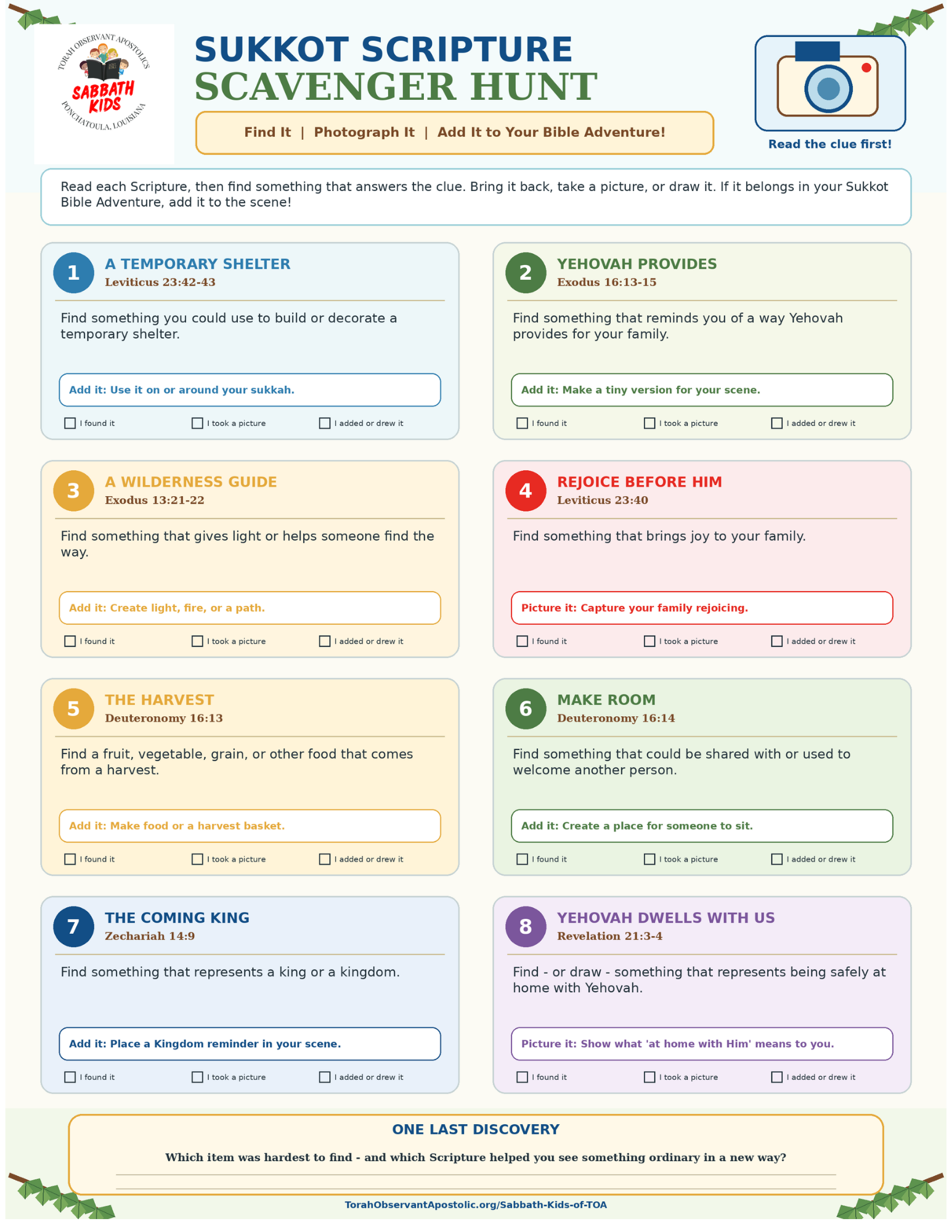
Go on a Sukkot Scripture Scavenger Hunt
We also created a Sukkot Scripture Scavenger Hunt that can be completed all at once or spread across the eight days.
But this is not just a list of random things to find.
Each clue begins with Scripture. Your family will read the verse, discover what to look for, and then find an object, take a photograph, or draw what you discovered.
Many of the scavenger-hunt discoveries can also be added to your Sukkot Bible Adventure scene.
Find it.
Photograph it.
Add it to your Bible Adventure.
Would You Like a Daily Reminder?
Sukkot can be a busy week, and it is easy for something meaningful to get buried beneath everything else competing for our attention.
If you would like a reminder when each new devotional is available, use the form below to sign up for email or text-message reminders.



One thought on “Sukkot Devotional: Experience Sukkot Through Scripture”