Have you ever faced a situation so overwhelming that your natural skills, resources, and backup plans were completely useless?
When the enemy surrounds you, the world tells you to sharpen your weapons, grind harder, and rely on your own strength. But heaven has a completely different strategy. In the Kingdom of Yehovah, spiritual posture matters far more than physical preparation.
The story of King Jehoshaphat in 2 Chronicles 20 gives us a masterclass in how to win battles when you are completely outmatched.
1. The Crisis: Facing Your “Vast Army”
2 Chronicles 20:1-4
1 It happened after this that the people of Moab with the people of Ammon, and others with them besides the Ammonites, came to battle against Jehoshaphat. 2 Then some came and told Jehoshaphat, saying, “A great multitude is coming against you from beyond the sea, from Syria; and they are in Hazazon Tamar” (which is En Gedi). 3 And Jehoshaphat feared, and set himself to seek the Lord, and proclaimed a fast throughout all Judah. 4 So Judah gathered together to ask help from the Lord; and from all the cities of Judah they came to seek the Lord.
The story opens with terrifying news for King Jehoshaphat: a massive coalition from Moab, Ammon, and Mount Seir has launched a surprise invasion. They are already marching toward Jerusalem, and Judah is vastly outnumbered.
Normally, a king’s first instinct is a military draft. You look at your swords, count your shields, and calculate your odds.
But Jehoshaphat recognizes that a physical solution cannot fix a spiritual threat. Instead of panicking, he resolves to seek the Lord. He proclaims a nationwide fast, and people from every single town in Judah leave their homes to assemble in Jerusalem.
The Takeaway: When a crisis hits, your first response shouldn’t be to fix it in the flesh. Your first response should be to fast, pray, and position your heart.
2. The Posture: Admitting You Don’t Know What to Do
2 Chronicles 20:5-13
5 Then Jehoshaphat stood in the assembly of Judah and Jerusalem, in the house of the Lord, before the new court, 6 and said: “O Lord God of our fathers, are You not God in heaven, and do You not rule over all the kingdoms of the nations, and in Your hand is there not power and might, so that no one is able to withstand You? 7 Are You not our God, who drove out the inhabitants of this land before Your people Israel, and gave it to the descendants of Abraham Your friend forever? 8 And they dwell in it, and have built You a sanctuary in it for Your name, saying, 9 ‘If disaster comes upon us—sword, judgment, pestilence, or famine—we will stand before this temple and in Your presence (for Your name is in this temple), and cry out to You in our affliction, and You will hear and save.’ 10 And now, here are the people of Ammon, Moab, and Mount Seir—whom You would not let Israel invade when they came out of the land of Egypt, but they turned from them and did not destroy them— 11 here they are, rewarding us by coming to throw us out of Your possession which You have given us to inherit. 12 O our God, will You not judge them? For we have no power against this great multitude that is coming against us; nor do we know what to do, but our eyes are upon You.”
Standing before the entire assembly at the Temple, Jehoshaphat prays one of the most powerful prayers in Scripture. He doesn’t beg; he stands on covenant promises:
He declares God’s sovereignty: He acknowledges God as the ruler over all kingdoms, possessing power no one can withstand.
He remembers past faithfulness: He reminds God of how He gave this land to the descendants of Abraham, His friend.
He claims the promise: He echoes Solomon’s temple dedication prayer—reminding God that when disaster, war, or plague hits, if His people cry out to Him, He will hear and save.
Then, Jehoshaphat strips away all human pride and drops a line that we all need to memorize for our own hard seasons:
“We have no power to face this vast army that is attacking us. We do not know what to do, but our eyes are on you.” (v. 12)
This is the ultimate spiritual shift. He moves from a defensive military posture to a totally dependent spiritual posture.
3. The Strategy: Replacing Steel with Song
2 Chronicles 20:14-19
14 Then the Spirit of the Lord came upon Jahaziel the son of Zechariah, the son of Benaiah, the son of Jeiel, the son of Mattaniah, a Levite of the sons of Asaph, in the midst of the assembly. 15 And he said, “Listen, all you of Judah and you inhabitants of Jerusalem, and you, King Jehoshaphat! Thus says the Lord to you: ‘Do not be afraid nor dismayed because of this great multitude, for the battle is not yours, but God’s. 16 Tomorrow go down against them. They will surely come up by the Ascent of Ziz, and you will find them at the end of the [a]brook before the Wilderness of Jeruel. 17 You will not need to fight in this battle. Position yourselves, stand still and see the salvation of the Lord, who is with you, O Judah and Jerusalem!’ Do not fear or be dismayed; tomorrow go out against them, for the Lord is with you.”
18 And Jehoshaphat bowed his head with his face to the ground, and all Judah and the inhabitants of Jerusalem bowed before the Lord, worshiping the Lord. 19 Then the Levites of the children of the Kohathites and of the children of the Korahites stood up to praise the Lord God of Israel with voices loud and high.
While the entire assembly—including women and children—is standing silently before the Lord, the Holy Spirit falls upon a Levite musician named Jahaziel. He delivers a shocking prophetic command:
“Do not be afraid or discouraged because of this vast army. For the battle is not yours, but God’s… You will not have to fight this battle. Take up your positions; stand firm and see the deliverance the Lord will give you.” (v. 15, 17)
Imagine the relief in the crowd. The pressure was off. In response, the king and all the people fall facedown to worship, and the musicians start praising God with incredibly loud voices. They hadn’t seen the victory yet, but they were already celebrating the promise.
4. The Divine Ambush: Praise is the Blade’s Edge
2 Chronicles 20:20-25
20 So they rose early in the morning and went out into the Wilderness of Tekoa; and as they went out, Jehoshaphat stood and said, “Hear me, O Judah and you inhabitants of Jerusalem: Believe in the Lord your God, and you shall be established; believe His prophets, and you shall prosper.” 21 And when he had consulted with the people, he appointed those who should sing to the Lord, and who should praise the beauty of holiness, as they went out before the army and were saying:
“Praise the Lord,
For His mercy endures forever.”
22 Now when they began to sing and to praise, the Lord set ambushes against the people of Ammon, Moab, and Mount Seir, who had come against Judah; and they were defeated. 23 For the people of Ammon and Moab stood up against the inhabitants of Mount Seir to utterly kill and destroy them. And when they had made an end of the inhabitants of Seir, they helped to destroy one another.
24 So when Judah came to a place overlooking the wilderness, they looked toward the multitude; and there were their dead bodies, fallen on the earth. No one had escaped.
25 When Jehoshaphat and his people came to take away their spoil, they found among them an abundance of valuables on the dead bodies, and precious jewelry, which they stripped off for themselves, more than they could carry away; and they were three days gathering the spoil because there was so much.
The next morning, the army marches out into the desert. But Jehoshaphat’s battle order defies all human logic.
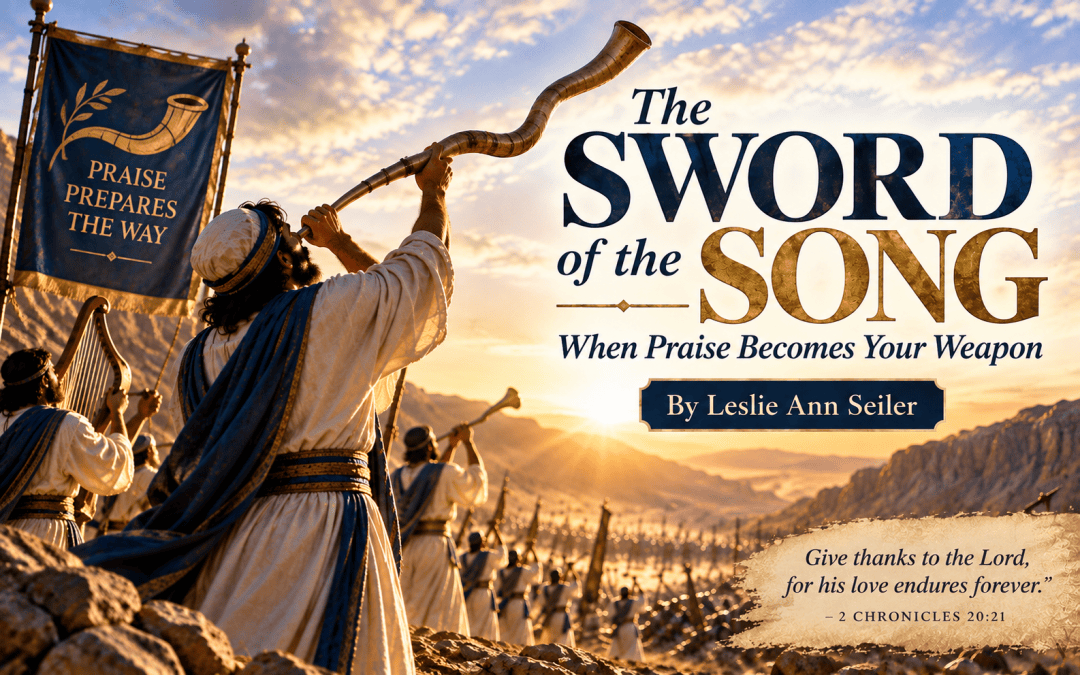
Instead of putting heavy infantry, chariots, or scouts at the front line, he appoints a choir to march out in front of the army.
They aren’t wearing physical armor; they are singing in the splendor of God’s holiness. And they aren’t singing a war cry—they are singing a song of thanksgiving:
“Give thanks to the Lord, for his love endures forever.”
Here is the supernatural turning point: The exact moment they began to sing and praise, the Lord set ambushes.
Confusion throws the enemy ranks into total chaos. The invading armies turn on each other, completely destroying one another. By the time Judah’s army reaches the lookout tower in the wilderness, all they see are dead bodies. No one escaped. They won the war without drawing a single sword.
5. The Valley of Berakah: Overflow and Rest
2 Chronicles 20:26-34
26 And on the fourth day they assembled in the Valley of Berachah, for there they blessed the Lord; therefore the name of that place was called The Valley of Berachah until this day. 27 Then they returned, every man of Judah and Jerusalem, with Jehoshaphat in front of them, to go back to Jerusalem with joy, for the Lord had made them rejoice over their enemies. 28 So they came to Jerusalem, with stringed instruments and harps and trumpets, to the house of the Lord. 29 And the fear of God was on all the kingdoms of those countries when they heard that the Lord had fought against the enemies of Israel. 30 Then the realm of Jehoshaphat was quiet, for his God gave him rest all around.
31 So Jehoshaphat was king over Judah. He was thirty-five years old when he became king, and he reigned twenty-five years in Jerusalem. His mother’s name was Azubah the daughter of Shilhi. 32 And he walked in the way of his father Asa, and did not turn aside from it, doing what was right in the sight of the Lord. 33 Nevertheless the high places were not taken away, for as yet the people had not directed their hearts to the God of their fathers.
34 Now the rest of the acts of Jehoshaphat, first and last, indeed they are written in the book of Jehu the son of Hanani, which is mentioned in the book of the kings of Israel.
The victory is so complete that the plunder—valuables, equipment, and clothing—takes three full days to collect.
On the fourth day, they gather in the valley to bless the Lord, naming it the Valley of Berakah (which means “Blessing”). They return to Jerusalem exactly how they left—marching straight to the Temple with joy, accompanied by harps, lyres, and trumpets.
Because God fought their battle, the fear of God falls on all the surrounding nations, and Jehoshaphat’s kingdom is given supernatural Shalom on every side.
🛡️ Prophetic Application for Your Life
Your greatest battles will never be won by striving, overthinking, or trying to manipulate outcomes in the natural realm.
When you feel overwhelmed and have no idea what to do next, stop trying to fight the battle with human weapons.
Turn your eyes to Him.
Your praise is not a reaction to the victory—it is the catalyst for it. Your praise is the edge of the blade. When you open your mouth to give thanks in the middle of the wilderness, God releases heaven’s ambush to clear your path.
Let everything that has breath praise the Lord!
by Leslie Ann Seiler