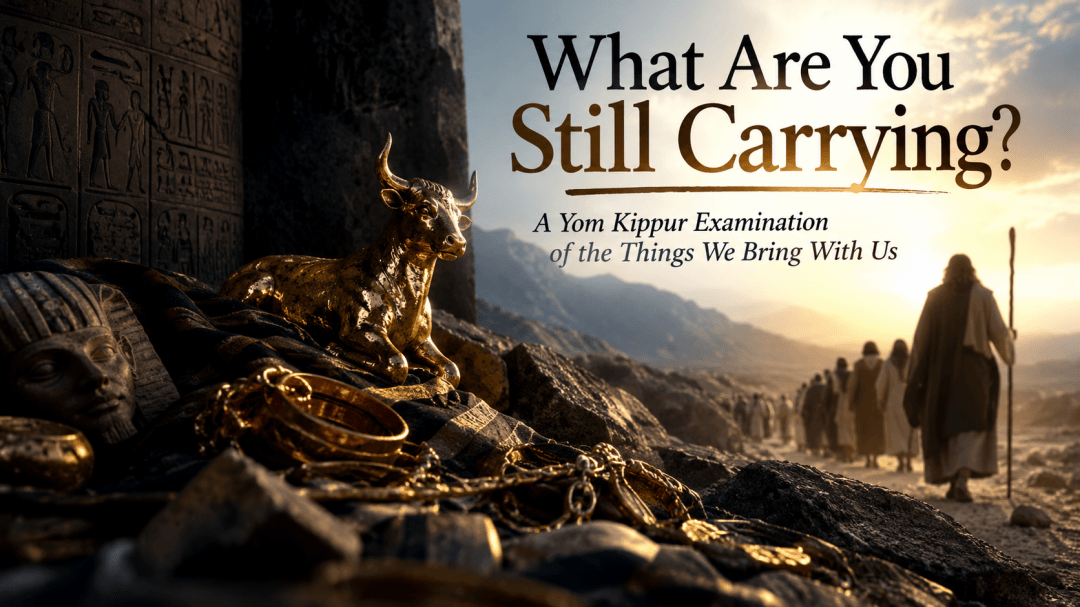
A Yom Kippur Examination of the Things We Bring With Us
Yom Kippur is a time for examination. It is a time to humble ourselves before Yehovah, look honestly at our lives, and allow Him to show us what needs to change.
Usually when we think about examining ourselves, we think about the obvious things. What have I done wrong? Where have I sinned? Is there someone I need to forgive? Is there something I need to repent of?
It’s all based on the idea that other than “transgressions” we commit at various times, we’re “good,” we’re “OK.”
But are we?
Don’t get me wrong, those are very important questions. But this year I want us to go a little deeper. What about the things we don’t recognize? What about the attitudes, assumptions, habits, fears, desires, and ways of thinking that have been with us for so long that they feel normal?
What if we carried some things out of Egypt?
They Left Egypt, But Egypt Came With Them
The Israelites had lived in Egypt for generations. However, Egypt wasn’t simply the place where they happened to live. Yes, they were slaves, but that did not make them immune to the culture that surrounded them, that they were immersed in. They lived among its gods, customs, values, religious practices, and ways of thinking. Israelite children were born there, grew up there, married there, and raised their own children there. Egypt was what they knew. For some it was all they knew.
Then Yehovah delivered them.
Their circumstances changed dramatically. They had been slaves under Pharaoh, but Yehovah brought them out with a mighty hand. They crossed the Red Sea in a miraculous way that was a type and shadow of baptism – deliverance. Pharaoh no longer owned them. They were free.
But leaving Egypt did not mean everything Egypt had taught them suddenly disappeared. They came out of Egypt, but Egypt had not completely come out of them.
We see that painfully demonstrated at Mount Sinai. Moses went up the mountain to meet with Yehovah, and when he did not return as quickly as the people expected, they became restless. They wanted something they could see. They wanted something familiar. So they made a calf to worship.
And they made it from gold.
Why Gold?
There is an interesting piece of Egyptian history worth noting here. Ancient Egyptians associated gold with the flesh of their gods and silver with their bones. Gold and silver could have religious significance in the culture in which the Israelites had lived for generations. Several historical and anthropological sources describe this Egyptian association specifically, along with the religious significance attached to precious metals and ornamentation.
Now, look again at what happened at Sinai. When Israel decided to make an image, they chose gold. Where did they get it? I promise you, Yehovah did not drop it down from the sky like manna, that’s for sure. It was the very gold they had carried out of Egypt.
Now, Scripture does not tell us why they chose gold, so I am not going to tell you that Egyptian religious beliefs were the reason. The Bible doesn’t tell us that. But knowing what we know about Egyptian culture, I do think it is worth noticing.
After all, if accessibility were the only issue, they could have used stones or sticks. Why gold?
That is a question worth rolling around for a bit. What had they seen in Egypt? What associations did gold already have in their minds? What ideas about gods, images, and worship had surrounded them throughout their lives?
We cannot definitively answer why they chose gold – Scripture doesn’t tell us. But that question leads us to another one that I think is far more important.
What else did they carry out of Egypt?
You Can Leave a Place and Still Carry Its Ways
The Israelites had been slaves in Egypt, but bondage doesn’t prevent influence. You can hate the place you’re in and still be shaped by it. We see that in prisons all the time.
You can long to escape something and still learn its ways. You can be delivered from an environment and discover later that the environment left something behind in you.
Think about what happened when Moses stayed on the mountain longer than they expected. Why did they reach for something familiar? What did their fear expose? What did their impatience expose? What had become so normal during their years in Egypt that they didn’t recognize it as something that needed to be left there?
Those are good questions to explore about Israel. But on Yom Kippur, we shouldn’t stop with Israel.
We need to explore them within ourselves.
We Came Out of Egypt, Too
Scripture uses the language of bondage when it talks about sin. Yeshua said, “whoever commits sin is a slave of sin” (John 8:34). Paul later wrote that those who have been set free from sin have become servants of righteousness (Romans 6:18).
So we understand something about Israel’s story. We know what it means to be in bondage, and through Yeshua we know what it means to be delivered.
But we have also spent our lives immersed in the world, and whether we recognize it or not, the world has been teaching us.
It set standards for us and taught us to live by those standards. It threatened failure, isolation, poverty, and unhappiness if we did not comply.
It has taught us what success looks like and what makes someone valuable. It has taught us where our identity comes from. It has taught us what we deserve, how we should respond when someone hurts us, what relationships should look like, whose approval matters, what we should fear, what should make us happy, and what is considered normal.
Then Yehovah called us out of it.
But did we leave all those ideas behind?
Don’t just say yes and move on. Sit with this for a bit and prayerfully seek after Yehovah. Let Him search you and reveal those things within you that are not profitable for the Kingdom.
Even if you don’t think it’s that big of a deal. Even if you think He probably hasn’t noticed (He has). Even if you think you can never put that down. Give it to Him.
Stop trying to give those things to Him with a closed fist.
The world will tell you to hang on to it for dear life. Yehovah tells you to give it to Him. And if you don’t ask Him, you may never know because it is so ingrained, so normal.
We can be delivered from bondage while still carrying ways of thinking that were formed there. That is why Paul tells believers not to be conformed to this world, but to be transformed by the renewing of their minds (Romans 12:2). Our circumstances can change much faster than our thinking does.
The Israelites crossed the Red Sea in a night. Learning to think like the people of Yehovah took considerably longer.
What Did You Carry With You?
This is where Yom Kippur becomes personal. It is easy to look around and see what everyone else needs to change. It is considerably harder to sit quietly before Yehovah and ask Him what we carried with us.
Maybe somewhere along the way you learned that your value depends upon what other people think of you. Maybe the world taught you that holding onto an offense protects you from being hurt again. Maybe success still means money, possessions, recognition, influence, or being admired.
Perhaps you learned to trust your feelings as the final measure of truth. Maybe there is something you have always believed Yehovah would never ask of you because obedience in that area would cost too much. Perhaps there is a tradition you inherited from people you trusted and loved, so you never thought to examine it against Scripture.
Or perhaps it is none of those things.
I don’t know what you carried out of Egypt.
And I don’t need to know.
This is not my examination. It is yours.
When “Normal” Needs to Be Examined
Some things are particularly difficult to recognize because they don’t feel wrong. They feel normal. We have seen them our entire lives. Everyone around us does them. People we respect may have taught them to us. Our culture reinforces them, and sometimes other believers do too.
So we never think to ask.
But “normal” isn’t the standard. The Word is.
That means sometimes Yehovah will challenge something you have believed for years. Sometimes He will show you that something you assumed was biblical actually came from somewhere else. Sometimes He will put His finger on something you have never questioned because you never imagined there was a question to ask.
That is part of renewing the mind. Sometimes the hardest thing to surrender isn’t something we do. It is something we believe.
And that raises a difficult question for Yom Kippur: Am I willing to allow Yehovah to tell me I’m wrong?
Not someone else. Not the person I disagree with. Me. And don’t be so quick to say yes. Think about it for a minute. How have you responded in the past when He convicted you or took something from you or moved something in your life and you didn’t agree with it?
How far does your obedience go? Until you get uncomfortable? Until you disagree? Until it challenges your very identity?
If you abide in Him, are one of His, you are a new creature (2 Corinthians 5:17). That type of transformation is often arduous. They don’t call them growing pains for nothing.
“You Shall Not Worship Yehovah Your God in That Way”
Deuteronomy 12 becomes especially interesting when we look at Israel through this lens. Yehovah was preparing the Israelites to live among nations whose ways were very different from His, and He warned them not to become curious about how those nations served their gods and then say, “I also will do likewise” (Deuteronomy 12:30).
He wasn’t merely telling Israel not to worship other gods. He was teaching them not to learn the ways of the nations and then bring those ways into their worship of Him.
That requires us to think. It requires us to stop assuming that something is acceptable simply because it is familiar. Where did I learn this? Why do I believe it? What does Scripture actually say? Have I assumed Yehovah approves of something simply because I have never asked Him about it?
Those aren’t questions someone else can answer for you. You have to be willing to open the Word, examine what you believe, pray, and listen – then change as Yehovah directs.
The Gold We Carry
There is something else about the golden calf that I don’t want us to miss. Gold itself wasn’t evil. Silver wasn’t evil. The Israelites weren’t sinning simply because they possessed something they had received in Egypt.
The problem was what they did with it.
Something they carried out of bondage became the material they used to build an idol in freedom.
That should make you think. It should make us all think.
We don’t need to become afraid of everything around us or start searching suspiciously for a pagan connection behind every object. That isn’t the point. The point is that we belong to Yehovah, and because we belong to Him, everything we carry should be available for His examination.
We don’t celebrate the world’s holidays because they have deep pagan roots and were how the pagans worshipped their gods. That’s what Deuteronomy 12:4 is talking about. It is reinforced in Leviticus 23 We don’t need to become afraid of everything around us or start searching suspiciously for a pagan connection behind every object. That isn’t the point. The point is that we belong to Yehovah, and because we belong to Him, everything we carry should be available for His examination.
At the same time, we can’t ignore pagan influence when Scripture specifically tells us not to adopt the ways the nations worshipped their gods and use those ways to worship Yehovah. That is the warning of Deuteronomy 12. We don’t celebrate the world’s religious holidays simply because they have become normal or because someone attached the name of God to them. Yehovah told His people not to learn how the nations worshipped their gods and then say, “I also will do likewise.” He didn’t leave Israel to decide for themselves how they wanted to worship Him.
He told them how.
Leviticus 23 gives us Yehovah’s appointed times—His feasts—and throughout Scripture we see His people observing what He established. Yeshua Himself walked according to Yehovah’s appointed times. So this isn’t about becoming suspicious of everything with an ancient origin. It is about being willing to examine what we have accepted from the world when Yehovah has already spoken.
And that principle reaches much further than holidays. Good things, ordinary things, even seemingly innocuous things can become idols when we give them a place Yehovah never intended them to have.when He gave us explicit instructions regarding how HE wants us to worship Him. And that command is demonstrated throughout scripture, including in the way Yeshua walked.
Our intelligence can become an idol. Our independence can become an idol. Our traditions, reputation, ambitions, pain, need for approval, or even our survival mechanisms can become things we protect from Yehovah’s hand.
Some things may even have helped us survive Egypt.
That doesn’t necessarily mean Yehovah intends us to carry them through the wilderness.
What Are You Still Carrying?
This is where I want to leave you for Yom Kippur. I am deliberately not giving you a list of things I think you should remove from your life. I don’t want you searching for my answer. I want you asking Yehovah for yours.
If you change something simply because a pastor, teacher, spouse, friend, or I tell you to change it, you can make an outward adjustment without anything really changing in your heart. You may comply, but compliance is not the same thing as conviction.
Deeper than that, if you change only because another person told you to, you have allowed that person to occupy a place in your obedience that belongs to Yehovah. No, you didn’t mean to do that at all, but your change is still centered on the person rather than the One who created you, loves you beyond measure, and to whom you ultimately answer.
I can give you information. I can show you Scripture. I can point out something interesting in the text and ask, “Why did they do that?” “Why did they make that choice?” I can encourage you to look more closely.
But I cannot do your examining for you, and I cannot manufacture your conviction.
Bring yourself before Yehovah with humility. Open His Word. Pray earnestly. Ask Him for direction, and approach Him with a genuine desire to obey whatever He shows you—not because someone pressured you, not because you are worried about what other believers will think, but because you love Him and want to please Him.
Take some time and pray, really pray. Psalm 139:23-24 is excellent for this type of internal cleansing. Pray it aloud. Pray it boldly. Ad most importantly, pray it because you mean it.
23Search me, O God, and know my heart;
Psalm 139:23-24
Try me, and know my anxieties;
24 And see if there is any wicked way in me,
And lead me in the way everlasting.
What Happens When We Spend Time With Yehovah?
Now I want to draw your attention to another person in the Exodus story. We need to examine his experience before we finish, because influence works in more than one direction.
Look at Moses when Yehovah first called him at the burning bush. Years earlier, Moses had tried to intervene for his people in his own way. He killed an Egyptian, hid the body, and fled when what he had done became known. By the time Yehovah met with him at the burning bush, Moses wasn’t volunteering to lead anybody.
He questioned himself. “Who am I, that I should go to Pharaoh?” Then he worried that the people wouldn’t believe him. When Yehovah answered that concern, Moses brought up his difficulty speaking. Finally, when he ran out of excuses, he simply asked Yehovah to send someone else.
But look at how Yehovah answered him. He didn’t build Moses’ confidence by telling him how talented, capable, or qualified he was. He told him, “I will certainly be with you” (Exodus 3:12). When Moses worried about speaking, Yehovah told him, “I will be with your mouth and teach you what you shall say” (Exodus 4:12).
Moses didn’t need greater confidence in Moses. He needed greater dependence on Yehovah.
And as Moses spent time with Yehovah, we begin to see him change. Scripture doesn’t stop the story and announce, Moses became bolder and more submissive. But watch him. The reluctant man at the burning bush eventually stands before Pharaoh again and again. The man who begged Yehovah to send someone else becomes the man leading an entire nation through the wilderness.
Then something even more beautiful happens. Moses was being transformed. He becomes an intercessor.
After Israel makes the golden calf, Yehovah tells Moses what the people have done. Moses could have separated himself from them. These were the same people who complained, questioned him, and made his job anything but easy. Instead, Moses pleaded for them. He asked Yehovah to turn from His wrath and remember His covenant with Abraham, Isaac, and Israel (Exodus 32:11–13).
Later Moses went even further. He told the people he would go before Yehovah and perhaps make atonement for their sin. Then he prayed, “Yet now, if You will forgive their sin—but if not, I pray, blot me out of Your book which You have written” (Exodus 32:32).
Think about the man saying those words. The man who once essentially said, Please send somebody else, is now standing between Yehovah and the people, pleading for them. Moses has become more than the man responsible for getting a crowd from Egypt to the Promised Land. He has become a shepherd who loves the people Yehovah entrusted to him.
And notice what spending time with Yehovah did not produce in Moses. It didn’t make him harsher toward people who were struggling. It didn’t make him stand at a distance and point out how much more righteous he was than they were. The closer Moses drew to Yehovah, the more humble he became – the more willing he became to intercede for people who had failed Him.
Think about that in the context of Yom Kippur. Moses had been on the mountain with Yehovah while the people were below making the golden calf. If anyone had reason to say, Look what they did while I was with Yehovah, it was Moses.
Instead, he pleaded for them.
That gives us another area in which to examine ourselves. What is spending time with Yehovah producing in me? Am I becoming more interested in finding the faults in everyone around me, or am I becoming someone who intercedes for them? Am I becoming proud of what Yehovah has shown me, or more aware of how desperately all of us need His mercy?
Then Exodus 34 gives us an extraordinary physical picture of what has been happening all along. Moses spends forty days and nights with Yehovah. When he comes down from Mount Sinai carrying the tablets, he doesn’t even realize that the skin of his face is shining because he has been speaking with Yehovah (Exodus 34:29).
Moses came down from the mountain reflecting the One he had been with.
But perhaps his face wasn’t the first thing that reflected Yehovah. His character had already begun to show evidence of the One he was spending time with. The reluctant man was becoming a leader. The man who once acted on his own was learning dependence and submission. The man who wanted someone else to carry the responsibility had become a shepherd willing to stand in the gap for his people.
There is one more detail I love about this. Moses didn’t know his face was shining. He wasn’t trying to look like someone who had been in the presence of Yehovah. He wasn’t checking to see whether other people could tell. In fact, everyone else noticed the change before he did.
There is something worth considering there. Real transformation doesn’t need to announce itself. When we genuinely spend time with Yehovah, the evidence should begin to show in our lives—not because we are trying to convince anyone of how spiritual we are, but because His presence changes us. The way we think changes. The way we respond changes. The way we treat people changes. The things we desire begin to change.
Moses didn’t come down the mountain saying, Look at me. Can’t you see I’ve been with Yehovah? He simply came down from being with Him, and it showed.
Maybe that gives us one more question to bring before Yehovah on Yom Kippur: If the people around me looked at my life, what influence would they see?
Would they see Egypt?
Or would they see evidence that I have been spending time with Yehovah?
That brings us right back to Egypt.
Israel showed evidence of what had influenced them there. Their years in Egypt had shaped what seemed familiar and normal to them. But Moses shows us the other side of influence. Yehovah was shaping him.
We are influenced by what surrounds us. We are shaped by what we continually listen to, watch, admire, think about, and give our attention to. Its language becomes familiar. Its assumptions begin to feel normal. Its values can quietly become ours without us ever consciously choosing them.
But the opposite is also true. The more time we spend in the Word, the more familiar Yehovah’s ways become. The more we pray, listen, submit, and obey, the more He changes the way we think. Things that once seemed normal may begin to trouble us. Things we once resisted may become precious to us. Our desires change. Our responses change. Even the way we see and respond to other people can change.
So perhaps our Yom Kippur examination shouldn’t end only with “What did I carry out of Egypt?”
There is another question we need to ask:
What does my life show that I have been spending time with?
Israel walked out of Egypt carrying gold. They were free. Pharaoh no longer owned them. But freedom from Pharaoh did not mean they were instantly free from everything Pharaoh’s world had taught them.
Neither are we.
There are things Yehovah must renew in us. There are assumptions He must challenge, attitudes He must uncover, and things He must teach us to see differently. Sometimes there are things we have carried a very long way before we realize He never asked us to carry them at all.
But Moses shows us something else. We don’t only have to be shaped by where we came from. We can be shaped by the One we spend time with.
Moses spent time with Yehovah, and it showed. His thinking changed. His responses changed. The reluctant man became a shepherd and an intercessor. Eventually, even his face reflected the glory of the One he had been with—and Moses didn’t even realize it.
Maybe that is the hope tucked inside this examination. Yehovah doesn’t simply show us what needs to be left behind. As we spend time with Him, He changes us. Egypt can lose its influence as His influence becomes greater.
So this Yom Kippur, don’t begin by looking around at everyone else. Look within. Open the Word and allow it to examine you. Ask Yehovah:
What am I still carrying from Egypt that You never intended me to bring into my covenant life with You?
And what does my life show that I have been spending time with?
Then don’t rush to answer either question yourself.
Be quiet long enough to let Him answer.


