My husband and I were discussing some of the things being posted on social media concerning Thanksgiving. After listening to some of the arguments people were making about why they think (emphasis on think) that Thanksgiving is a sin, he sighed, rolled his eyes, and said, “Well, there’s people out there who think that fresh air is a sin. I just don’t know where people’s minds are anymore.”
As amusing as that comment is, it addresses something very sobering – something that concerns me considerably.
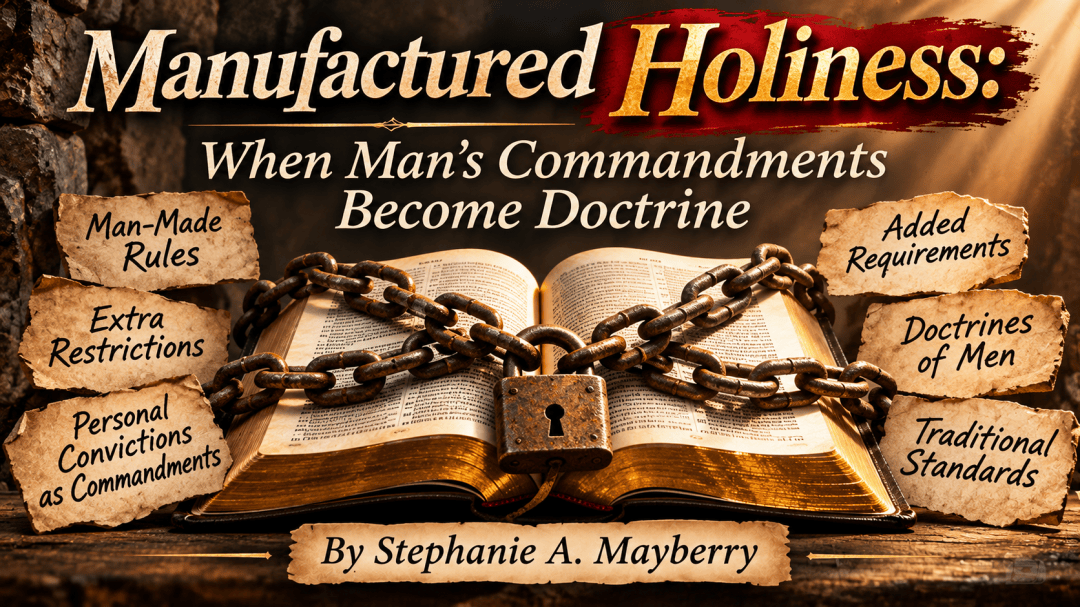
There seems to be a growing number of people who believe that the more restrictions they place upon themselves and others, the more holy they are. And in doing so, they’re establishing prohibitions that aren’t found anywhere in Scripture, presenting their personal convictions as biblical commandments, and condemning people who don’t adhere to the standards they’ve established.
And many of these people are doing it in the name of Torah observance.
They are acting just like the Pharisees of Yeshua’s time.
Now, just to be clear, I am Torah observant. I believe in obedience to Yehovah’s commandments, and I will make no apologies for that. But there are people out there who also claim to be Torah observant yet are furiously adding to His commandments and taking away from them in order to fit their lack of understanding.
Typically, these people only see the truth of Torah and never even entertain the Spirit. Yeshua said that we are to worship in both Spirit and truth (John 4:23–24). If you are just focusing on one, then you only have half of the equation.
And this concerns me greatly. It is disobedience, but worse, they are promoting and teaching these half-truths and heresy, selling them as the full gospel.
And people are buying it, lock, stock, and barrel.
When you teach people about Yehovah and His Word, Yehovah holds you to a higher standard (James 3:1). So if you are misrepresenting Him or teaching heresy, that is very serious.
That is a salvation issue.
The Other Half of the Commandment
You shall not add to the word which I command you, nor take from it, that you may keep the commandments of the LORD your God which I command you.
Deuteronomy 4:2 (NKJV)
As Torah observant believers, we frequently address the teachings that have led people to disregard the Sabbath, the biblical Feast Days, and other commandments Yehovah established for His people. We encourage people to examine Scripture for themselves rather than blindly accept the religious traditions they’ve been taught.
But are you exercising that same discernment when someone tells you that something is a sin?
When someone tells you that you cannot eat a particular food, wear a particular garment, participate in a particular activity, or observe a particular day, are you examining the Scriptures to determine whether Yehovah actually established that prohibition?
Or are you accepting it because the person telling you these things appears to be knowledgeable about Torah?
You can leave a religious system that takes away from the Word of Yehovah and find yourself embracing a religious system that adds to it. You’ve exchanged one set of man’s doctrines for another, but you haven’t resolved the underlying problem.
You’re still allowing man to establish the standards by which you live rather than allowing Yehovah to establish those standards through His Word.
More Restrictive Does Not Necessarily Mean More Holy
Now let’s flip over to Colossians 2:20–23. I want you to read it carefully.
Here’s what’s going on.
Paul is addressing regulations concerning what people could touch, taste, and handle. Pay particular attention to his description of these regulations in verses 22 and 23. He identifies them as commandments and doctrines of men and describes them as having an appearance of wisdom in self-imposed religion, false humility, and neglect of the body.
An appearance of wisdom.
Something can look very religious. It can require considerable sacrifice and discipline. It can even impress people with the apparent dedication of those who practice it. But none of those things establishes that Yehovah required it.
And none of those things necessarily makes a person holy.
Now, understand that I am not suggesting that the commandments of Yehovah are the self-imposed religious regulations Paul is addressing. There is nothing self-imposed about obeying a commandment that Yehovah established.
I’m addressing the restrictions people manufacture themselves and then attempt to give the authority of Scripture.
You cannot become more obedient to Yehovah by obeying commandments He never gave you.
You can certainly make personal decisions about things you choose to abstain from. There may be very good reasons for you to make those decisions. But abstaining from something Yehovah has not prohibited does not automatically make you more holy than the person who doesn’t abstain from it.
If you want to examine the evidence of spiritual growth in your life, take a look at Galatians 5:22–23. How are you doing with love, patience, kindness, gentleness, and self-control? How are you treating the people who don’t agree with you? Are you growing in your obedience to Yehovah and becoming more like Yeshua in your conduct?
Or are you simply accumulating a longer list of things you don’t do?
There is a difference.
The Dangerous Pursuit of Our Own Righteousness
For I bear them witness that they have a zeal for God, but not according to knowledge. For they being ignorant of God’s righteousness, and seeking to establish their own righteousness, have not submitted to the righteousness of God.
Romans 10:2–3 (NKJV)
Zeal is not a substitute for knowledge, and sincerity is not a substitute for truth.
You can be absolutely convinced that you’re doing something to honor Yehovah and still be operating outside of His instructions. You can be passionate about holiness while pursuing a standard of righteousness that you’ve established for yourself.
Consider what Paul is saying here. These people had a zeal for God, yet in their pursuit of their own righteousness, they had failed to submit to His righteousness.
That’s a dangerous place to be, particularly when you begin teaching others to pursue the same standards you’ve established.
Do not be overly righteous, nor be overly wise: Why should you destroy yourself?
Ecclesiastes 7:16 (NKJV)
Can you be too obedient to Yehovah? Of course not. But you can become so consumed with establishing your own standards of righteousness that you lose sight of what He actually requires of you.
And if your pursuit of holiness has become a means by which you measure your spiritual superiority over others, you need to examine what’s going on in your heart.
Holiness is not a competition to see who can abstain from the most things. It isn’t about establishing yourself as the most knowledgeable, the most separated, or the most spiritually mature person in your congregation or social media group.
Your pursuit of holiness should be rooted in your love for Yehovah and your desire to be obedient to Him.
The Very Thing Yeshua Rebuked
People frequently refer to the Pharisees when addressing legalism, but I think we need to understand what Yeshua was actually rebuking.
He wasn’t rebuking people for obeying the commandments of Yehovah. Yeshua Himself lived in obedience to those commandments.
He was addressing hypocrisy, the elevation of man’s traditions, the neglect of the weightier matters of the law, and the burdens people placed upon others.
For they bind heavy burdens, hard to bear, and lay them on men’s shoulders; but they themselves will not move them with one of their fingers.
Matthew 23:4 (NKJV)
Read Matthew 23 in its entirety. Pay particular attention to verse 23, where Yeshua addresses people who were meticulous about tithing but neglected justice, mercy, and faith.
He didn’t tell them to stop doing the things they were doing in obedience to Yehovah. He told them they should have done those things without neglecting the others.
Now turn to Mark 7:6–13. Yeshua addresses people who had elevated their traditions to the point that those traditions were being used to circumvent the commandments of Yehovah.
How ironic is it that some of the people who are so vocal about rejecting the traditions of men are establishing traditions and prohibitions of their own and expecting others to adhere to them?
You haven’t eliminated the problem of man-made doctrine simply because your man-made doctrine is different from someone else’s.
Before you condemn someone for adhering to a tradition of man, make certain that the standard by which you’re condemning them isn’t also a tradition of man.
Personal Conviction Is Not Universal Commandment
There are things I don’t do because I have a personal conviction concerning them. There are things you may not do because you have a personal conviction concerning them.
And that’s fine.
I encourage you to seek Yehovah concerning the things you incorporate into your life. Be sensitive to the direction of His Spirit, and if He directs you to abstain from something, obey Him.
But you need to understand the difference between the direction Yehovah gives you concerning your individual life and the commandments He has established for His people.
If Yehovah has established a commandment in His Word, I don’t need to wait for a personal conviction to obey it. Likewise, my lack of personal conviction doesn’t give me permission to disregard something He has prohibited.
Personal conviction does not override Scripture.
However, in matters where Scripture has not established a commandment or prohibition, you don’t have the authority to take your personal conviction and impose it upon someone else as though it were a commandment from Yehovah.
I have a personal conviction to wear long skirts and sleeves to the elbow. I am not comfortable leaving the house in short sleeves, and even skirts that are mid-calf are not comfortable for me. However, I would never teach the ladies in our congregation that they must dress exactly as I do. The biblical standards don’t go quite that far, even though there are those who will attempt to manufacture Scripture to support it.
But it isn’t there. It’s a personal conviction. The Holy Spirit that dwells in me said no, so I obey. If the Holy Spirit convicts them to wear sleeves covering the elbows or long skirts, I am happy to support them. If not, well, that’s fine too. It’s not my business. My teaching on obedience ends where Scripture does. The Holy Spirit convictions that occur after are part of the refining process, and they are very personal – between them and Yehovah.
Read Romans 14. Look at how Paul addresses the treatment of fellow believers in matters of conscience. Look at the questions he asks in verses 4 and 10 concerning the judgment of another person’s servant and the judgment of a brother.
Then read James 4:11–12.
There is one Lawgiver.
You aren’t Him.
If you have a personal conviction concerning something and someone asks you about it, share it with them. Explain why you’ve made that decision. Share the Scriptures that have influenced your decision, if applicable, and encourage them to pray and seek Yehovah.
But don’t confuse sharing your conviction with establishing a requirement for someone else’s obedience.
The Responsibility of Those Who Teach
I see a considerable amount of teaching on social media that concerns me. People are making statements about what Yehovah requires, what He prohibits, what constitutes sin, and what believers must do to be obedient to Him.
And when you examine the Scriptures they provide to support their statements, sometimes those Scriptures have absolutely nothing to do with what they’re teaching – or worse, they have no scriptural support at all. They made it all up in their own minds.
Now the purpose of the commandment is love from a pure heart, from a good conscience, and from sincere faith, from which some, having strayed, have turned aside to idle talk, desiring to be teachers of the law, understanding neither what they say nor the things which they affirm.
1 Timothy 1:5–7 (NKJV)
I want you to pay particular attention to that last verse.
These people desired to be teachers of the law, but they didn’t understand what they were saying or the things they were affirming.
The desire to teach doesn’t qualify you to teach. Neither does your ability to find a Scripture reference that contains a word or phrase that appears to support your position.
You need to understand what you’re teaching, and you need to understand the Scriptures you’re using to teach it.
James 3:1 warns us about becoming teachers because teachers will receive a stricter judgment. That’s something you need to take very seriously before you assume the responsibility of teaching others what Yehovah requires of them.
And yes, when you get on social media and begin instructing people concerning the commandments of Yehovah, you are teaching.
What Does the Scripture You’re Quoting Actually Say?
I want to give you a couple of examples of why this concerns me. These are actual comments from social media concerning the observance of American Thanksgiving. I’ve reproduced them without identifying the individuals because my purpose is to address the teaching, not the person.
Here is the first comment:
Yes, it’s a sin against Israelites, YHWH chosen ppl. Celebrating it is joining in with Israelite enemies who conquered them. Psalm 83:1-4, Psalm 137:7…YHWH doesn’t approve of celebrating the destruction of His people.
There are some rather significant claims being made here, so let’s examine the Scriptures being used to support them.
Read Psalm 83 in its entirety. The first four verses address enemies conspiring against the people of Yehovah. Continue reading through verses 6–8, where several of those enemies are specifically identified, including Edom, Moab, Ammon, Amalek, and Assyria.
Now read Psalm 137. The first verse establishes the historical context of the psalm by identifying Babylon. Verse 7 addresses the conduct of the Edomites in connection with the destruction of Jerusalem.
Where is the connection between either of these psalms and American Thanksgiving?
Who are the Israelites being referred to in this comment? Who are the enemies? What historical evidence establishes that American Thanksgiving was instituted to celebrate the destruction of the Israelites? And how do these two psalms establish that someone observing Thanksgiving today is joining with those enemies?
Those connections haven’t been established in the comment. They’ve simply been asserted.
You cannot expect someone to accept a conclusion as biblical simply because you’ve included a couple of Scripture references.
I encourage you to open your Bible whenever you encounter a teaching like this. Read the verses being referenced, read the surrounding verses, establish the historical context, and determine whether the Scriptures actually support the conclusion being presented.
Don’t assume that someone has done the work simply because they’ve provided you with Scripture references.
Putting a Scripture reference at the end of your opinion does not transform your opinion into the Word of Yehovah.
Biblical Discernment Applies to the Things You Agree With, Too
Now I want to show you another comment concerning Thanksgiving, but this one comes from someone who supports its observance.
No, Thanksgiving is not a sin when giving praise and honor to YHWH our Creator God.
Our Ancestors made an oath towards YHWH, they were thankful and made an oath that we have to upkeep.
Numbers 30:2 KJV
“[2] If a man vow a vow unto the LORD, or swear an oath to bind his soul with a bond; he shall not break his word, he shall do according to all that proceedeth out of his mouth. ”
Ecclesiastes 5:4-5 KJV
“[4] When thou vowest a vow unto God, defer not to pay it; for he hath no pleasure in fools: pay that which thou hast vowed.
[5] Better is it that thou shouldest not vow, than that thou shouldest vow and not pazy. ”
So we are bound by the oath made by our Ancestors.
Similar to Chanukah/ festival of Re-Dedication of the Temple.
Or Purim made by Esther.
Remember that we are grafted into Israel, we are not the roots…
Without Chanukah and Purim there is no Messiah…
Blessings to you.
Shalom.
If you’ve read my article, Is Thanksgiving Pagan? Understanding Deuteronomy 12, you know that I don’t believe Scripture prohibits the observance of American Thanksgiving.
But I also don’t believe Scripture requires it.
Let’s look at Numbers 30:2. Who made the vow? Who bound his soul with a bond? Who is instructed not to break his word?
Now read Ecclesiastes 5:4–5. Who is instructed to pay the vow? The person who made it.
Neither of these Scriptures establishes that every vow made by an ancestor automatically becomes a binding obligation upon all subsequent generations.
Scripture does record specific agreements that affected subsequent generations. You can read about the oath made to the Gibeonites in Joshua 9 and the consequences of violating that agreement in 2 Samuel 21:1–2. But that was a specific agreement made under specific circumstances, and Scripture establishes the continuing obligation.
That doesn’t establish a universal principle that you are bound by every religious vow an ancestor may have made.
And before we even get to that discussion concerning Thanksgiving, there are some questions that need to be answered. What oath was made? Who made it? What were the terms of the oath? Where is the historical documentation of that oath, and where is the biblical basis for asserting that it binds us today?
A presidential proclamation encouraging a national observance of thanksgiving is not a covenant established by Yehovah.
As for Hanukkah and Purim, there is a distinction between the historical events those observances commemorate and the annual observances themselves. You cannot establish that the coming of Messiah was dependent upon the annual observance of either commemoration.
Doing so limits the power and authority of Yehovah. Either He is the God of the universe or He isn’t.
I included this comment because I want you to understand something very important about biblical discernment.
I cannot reject the misuse of Scripture when it contradicts my position and then embrace the misuse of Scripture when it supports my position. My responsibility is to preserve the truth of the Word of Yehovah, not to defend my position at the expense of that truth.
If you’re genuinely seeking truth, you need to exercise the same discernment when examining information you agree with as you do when examining information you disagree with.
One person is attempting to establish that Thanksgiving is prohibited. Another is attempting to establish that we’re obligated to observe it.
Neither has established their claim from Scripture.
And neither has the authority to manufacture a commandment.
Who Are You Trying to Glorify?
Social media has given people a platform from which they can reach a considerable number of people. That can be a tremendous blessing when it’s used to share the truth of Yehovah’s Word.
But it can also become a means of self-promotion.
He who speaks from himself seeks his own glory; but He who seeks the glory of the One who sent Him is true, and no unrighteousness is in Him.
John 7:18 (NKJV)
I think this is something everyone who teaches needs to examine periodically.
Why are you teaching? What are you trying to accomplish? Are you trying to help people develop a relationship with Yehovah, understand His Word, and walk in obedience to Him? Or are you more concerned with establishing yourself as someone who possesses knowledge that others don’t have?
Do you find yourself looking for some new revelation, some obscure interpretation, or some additional restriction that will distinguish you from other believers?
And what happens when someone questions what you’re teaching? Are you willing to open your Bible with that person and examine the Scriptures? Are you willing to acknowledge that you may have misunderstood something?
Or do you become offended because someone has challenged your knowledge or authority?
Read Matthew 23:5–12. Look at what Yeshua says concerning those who desire recognition, positions of honor, and titles.
We don’t need theological rock stars. We need people who love Yehovah, love His truth, love people, and are willing to do the work required to handle His Word responsibly.
You’re not supposed to be promoting yourself. You’re supposed to be promoting Yehovah and His truth.
And if you’re more concerned about being recognized as a teacher than you are about accurately representing the One you’re teaching about, you need to get in your prayer closet and address that.
Are You Driving People Away From Yehovah?
Imagine someone who has spent their entire life attending a church that observes Sunday worship and the traditional Christian holidays. They begin studying Scripture and discover the biblical Sabbath. They begin learning about the Feast Days and understanding the importance of obedience to Yehovah.
They’re excited about what they’re discovering, but they also have questions. They’re trying to reconcile what they’ve been taught all their lives with what they’re now seeing in Scripture.
So they join a few Torah observant social media groups, hoping to find people who can help them.
And suddenly they’re being told that all sorts of things are sinful. They’re being presented with restrictions that have no scriptural foundation, questionable historical claims, conflicting interpretations, and accusations against people who don’t adhere to someone else’s personal convictions.
They ask a sincere question and are treated as though they’re rebellious or spiritually immature because they don’t immediately accept what someone tells them.
Suddenly, Sabbath, the Feast Days, and serving Yehovah have become a burden.
Eventually, they become so overwhelmed and discouraged that they walk away.
Now, I want you to consider something. Did that person reject the Torah of Yehovah, or did that person reject the distorted representation of Torah that was presented to them?
There is a considerable difference between helping someone understand what Yehovah requires and placing unnecessary burdens upon someone who is sincerely seeking Him.
But woe to you, scribes and Pharisees, hypocrites! For you shut up the kingdom of heaven against men; for you neither go in yourselves, nor do you allow those who are entering to go in.
Matthew 23:13 (NKJV)
Think about the responsibility you have when someone comes to you seeking truth.
You don’t know how long that person has been praying for understanding. You don’t know what it has cost them to begin questioning the things they’ve been taught. They may be facing opposition from their family, their friends, or the congregation they’ve attended for years.
They need someone who will open Scripture with them, answer their questions, and help them learn how to study the Word of Yehovah for themselves.
They don’t need someone adding unnecessary obstacles to their spiritual walk.
And please understand that I am not suggesting that we compromise the Word of Yehovah to make obedience more appealing. There are commandments people will struggle with, and we cannot change those commandments to accommodate their struggles.
But we certainly don’t need to manufacture additional struggles for them by imposing restrictions Yehovah never established.
Build bridges to the truth. Don’t build walls around it.
Study Before You Speak
Ignorance can be educated. There isn’t anything wrong with not knowing something, provided you’re willing to learn.
I don’t expect you to know everything about Scripture. I certainly don’t know everything about Scripture, and I have spent a considerable portion of my life studying it.
But there is a difference between not knowing something and teaching something you don’t know.
If you don’t understand a particular subject, study it. If someone asks you a question and you don’t know the answer, tell them you don’t know. There is no shame in that. You can even offer to study it with them.
You don’t have to have an answer for every question, and you certainly don’t need to manufacture an answer to preserve someone’s perception of your knowledge.
Be diligent to present yourself approved to God, a worker who does not need to be ashamed, rightly dividing the word of truth.
2 Timothy 2:15 (NKJV)
When you’re preparing to teach something, read the Scriptures in context. Establish who is speaking, who is being addressed, what circumstances are being addressed, and what instructions are being given. Compare what you’re reading with other Scriptures that address the same subject.
If you’re making historical claims, investigate them. Find out where the information originated. A graphic someone posted on Facebook is not historical documentation, and the fact that you’ve seen the same claim repeated by several people doesn’t establish that it’s true.
And if you discover that something you’ve been teaching is incorrect, correct it.
If you’ve taught it publicly, consider the responsibility you have to correct it publicly. There may be people who have accepted what you taught and are now teaching it to others.
You should be more concerned about those people having the truth than you are about protecting your reputation.
Whose Standard of Holiness Are You Pursuing?
I believe holiness is a requirement, not a suggestion. I believe obedience to Yehovah is essential, and I will continue to encourage people to study His Word and walk in obedience to His commandments.
But defending the sufficiency of Yehovah’s commandments is not compromising holiness.
We aren’t advocating lawlessness by refusing to add to His law. We’re respecting His authority as the Lawgiver.
Before you declare something sinful, establish that from Scripture. Before you impose a requirement upon someone else, establish that Yehovah actually requires it. Before you share a teaching, make certain you understand what you’re teaching.
And examine your own heart. Are you pursuing holiness because you love Yehovah and desire to be obedient to Him, or have you become so consumed with the restrictions you’ve placed upon yourself and others that those restrictions have become the measure of your righteousness?
Read Micah 6:8.
He has shown you, O man, what is good;
Micah 6:8
And what does the LORD require of you
But to do justly,
To love mercy,
And to walk humbly with your God?
There is humility in acknowledging that Yehovah knows better than you do. There is humility in submitting to His commandments without feeling the need to improve upon them. And there is humility in recognizing that you do not possess the authority to establish the requirements for someone else’s righteousness.
Seek Yehovah. Study His Word. Obey His commandments. Be sensitive to the direction of His Spirit, and exercise discernment concerning the things you accept and the things you teach.
He has already given us His standards.
We don’t need to manufacture our own.
Related Reading
Is Thanksgiving Pagan? Understanding Deuteronomy 12
Scripture quotations identified as NKJV are from the New King James Version®. Copyright © 1982 by Thomas Nelson. Used by permission. All rights reserved.


